

2015 Fall BOG: Martinsville
December 2, 2022
The 2015 fall Board of Governors meeting was hosted by the Martinsville Garden Club on October 13-15, 2015, at the New College Institute, co-chaired by Nancy Moore and Sue Rosser. Photos
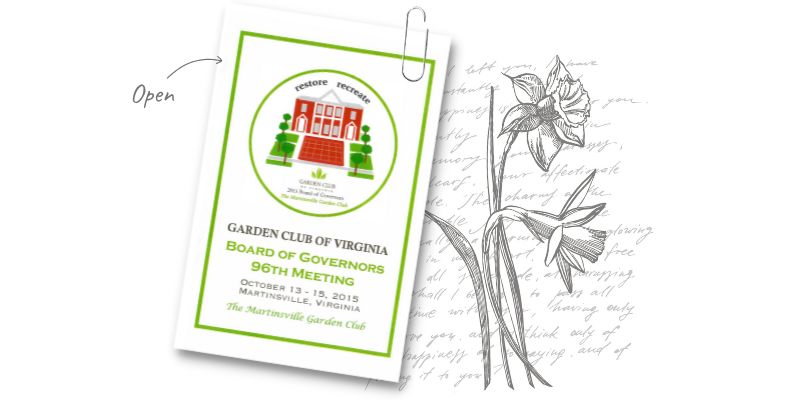
The Board of Directors met Tuesday afternoon for lunch at the home of Susan and Will Pannill, followed by the meeting at the Hampton Inn.
Lynn McCashin reported that the UCI Road World Championships took place in Richmond on September 19-27, 2015, and left the staff feeling disconnected, as the Kent-Valentine House was closed due to parking and traffic restrictions. She added that a search has begun for a replacement Director of Development, a job that has grown to a full-time position, stating that a Blackbaud consultant will be providing technical assistance for the Raiser’s Edge conversion in the interim.
Development Committee Chairman Jean Gilpin invited Jeanette Cadwallender, Lynn McCashin and Anne Cross to a meeting of the Development Committee on September 17 at the Kent-Valentine House for discussions, including updates to Director of Development job description; the search for Karmen’s replacement; HGW sponsorships; the recently canceled wine initiative; and Partnership for Parks. Jean was pleased to learn that Bartlett Tree Experts will once again be a state sponsor for the 2016 HGW Guidebook and state brochure, and that IMVA has agreed to sponsor the 2015 GCV Conservation Forum.
Historic Garden Week Chairman Meg Clement was pleased to report that Bartlett Trees will continue to partner with the Garden Club of Virginia, sponsoring the 2016 HGW Guidebook for the fourth consecutive year, and that Directors at Large were added to the committee to provide a stronger link between Historic Garden Week and member club presidents.
Flower Shows Committee Chairman Lea Shuba reported that her committee met with upcoming flower show host clubs to address concerns, with finances being a top priority. Lea did extensive research on past show expenses and presented a comprehensive report to address the most pressing financial problems: facility rental, box lunches, judges’ dinner, printing, postage, aprons, properties and flowers. In discussing each cost area, Lea’s report offered viable solutions. Her report also included ideas for combining shows to reduce manpower requirements. Lea moved that host clubs for the Daffodil Show be given an additional $1,500, bringing the total to $5,000. After a lengthy discussion, the Board voted to expand funding to give all flower show hosts clubs an additional $1,500.
The meeting was adjourned and executive session followed.
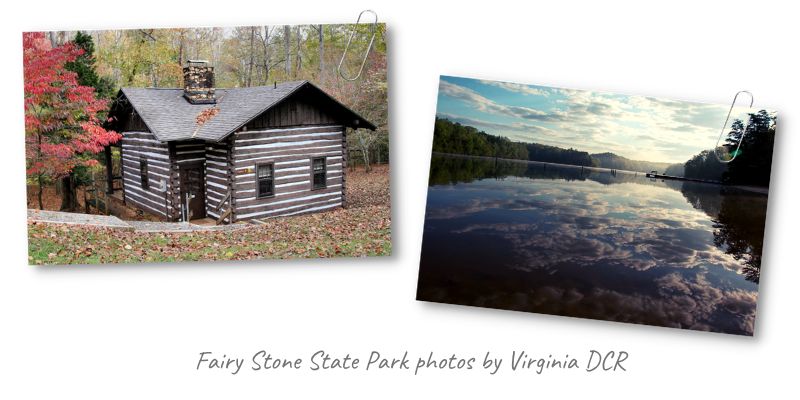
Tuesday arrivals gathered for a lively evening of cocktails and Dutch treat dinner at Hamlet Vineyards. Optional tours on Wednesday morning included visits to Fairy Stone State Park or recent Restoration site Historic Henry County Courthouse.
President Jeanette Cadwallender called the Board of Governors meeting to order Wednesday afternoon and introduced Martinsville Garden Club President Becky Farrar. Becky called upon MGC past president Lucy Wilson to “continue our welcome as only Lucy can do!”
Lucy began,
“Hello pretty ladies and you do really look great! I wish you could see what I’m seeing. Not only does the Martinsville Garden Club welcome you, but also the City of Martinsville. This city started out as a little village farming mostly tobacco, but we were successful at that with several tobacco companies. Then the founding fathers realized our many hardwood forests could provide needed lumber for building, so sawmills were started. It wasn’t long before these same men realized we could build furniture right here so a number of large furniture factories opened up. You might have read the best seller, Factory Man, which took place nearby in Bassett. Then the women wanted to work outside the home so textile mills opened. The first two items made were long johns and bloomers! But then the magic word appeared, “fleece.” If you have ever had a sweatshirt in the past, it probably was made in Martinsville, which became “the sweatshirt capital of the world.” Our former duPont plant even made the nylon for parachutes for World War II. All these things have changed now, but we are rebuilding with new companies. There is one commodity that never has changed here. It’s the intangible factor of hospitality. We’ve had it for generations so it is my hope for you that you feel welcomed and are having a good time here with us. Thank you.”
Jeanette opened by repeating remarks from her visits to member clubs that describe the women who founded the GCV in 1920. “These women were intelligent, well-educated women who cared deeply about the public well-being. They found a voice that was stronger than their individual voice; they found that by working together they could improve their communities. The descendants of these women are here today.”
In closing, Jeanette said, “Tomorrow has been declared Garden Club of Virginia Day in Henry County and the town of Martinsville. Tomorrow’s agenda will commence after our opening speaker, Craig Seaver, Director of Virginia State Parks, and must conclude in time for the presentation at the Historic Henry County Courthouse.”
Kent-Valentine House Committee Chairman Kay Tyler reported on maintenance projects: floor replaced in the new kitchen at no cost because incorrect adhesive was used; sporadically working ice machine repaired; chairs in third-floor meeting room reupholstered. She also reported that a Richmond Regional Energy Alliance (RREA) energy audit has been completed and shared with Taylor & Parrish for their annual walk through of buildings and grounds.
Conservation and Beautification Committee Chairman Tuckie Westfall provided updates on the Dominion Power-proposed power lines across the James River; proposals to run pipelines through the southwestern Virginia mountains, forests and private properties; and proposed development of Fones Cliffs in Richmond County. Tuckie then introduced Nikki Andresen, the first recipient of the GCV Conservation and Environmental Studies Fellowship, and her professor, Bonnie Brown of Virginia Commonwealth University. Nikki gave an in-depth presentation of her research on the endangered yellow pitcher plant.
Flower Shows Committee Chairman Lea Shuba expressed concern about the future of GCV flower shows. A strategic planning survey of club presidents had shown tremendous support for flower arranging and artistic design, with Flower Arranging School being one of GCV’s most well-attended events. But the same survey showed very little support for flower shows, and a stunning lack of support in hosting flower shows, with high cost and lack of manpower being the biggest hurdles. Lea stated that her committee was not charged with determining the future of flower shows, but rather with ensuring the success of each one. She envisioned a bright future for flowers shows, but not without a lot of work. Her committee is working with the current flower show format, but she noted that changes had been made based on comments from members and host clubs. Lea continued, “When this club was founded almost a hundred years ago, they did not choose to name it the Conservation or Flower Arranging Club of Virginia, because it is so much more than these are. They chose to call it the Garden Club, and from there they had the vision to consider it from multiple aspects — how to preserve gardens, restore them, glorify them and educate themselves and others about all of these aspects. This vision has produced a club that is almost unique in its appeal to women with many different interests, but all of us cherish most the fact that it gives us a place to interact with like-minded individuals. I know that not everyone sitting here is a flower arranger, but I also know that if you wish to become one, we provide you the means.”

Centennial Committee Chairman Anne Cross read from the Richmond Times Dispatch of December 18, 1929, “Resolutions calling for the establishment of a system of State Parks and a system of State Forests and urging the 1930 General Assembly to appropriate at least $50,000 for each year of the next biennium for the park system, were adopted yesterday at a meeting of representatives of civic organizations from all parts of the Old Dominion, held in the Capitol, under the auspices of the Virginia Academy of Science, the Garden Club of Virginia and the Association of Izaak Walton League Chapters of Virginia.” She reminded attendees that the GCV Board of Directors had approved a challenge grant gift in January 2014, of $500,000 payable in increments of $100,000 over five years to the Partnership for Parks and listed the first-year applicants: Natural Bridge, Mason Neck, Caledon, Belle Isle and False Cape. She added that members of the VHS exhibition subcommittee are searching for GCV records at the Library of Virginia, the Virginia Historical Society, Alderman Library at UVA and the Kent-Valentine House. Volumes of Follow the Green Arrow have been digitalized and are available online, but those volumes do not document anything beyond 1995. The idea of updating Follow the Green Arrow is still viable, but the consideration of print versus digital remains in question. Anne requested assistance from the Development Committee to work with Jo Catron and Andrew Talkov as the exhibition outline developed over the summer to assist with writing grant applications as needed. The cost of the exhibition is estimated at $40,000.
Following business reports, attendees broke for roundtable discussions, with each attendee attending selecting two of the following:
- Membership: attracting members and categories of membership, led by Kris Carbone
- Partnering with State Parks: finding ways to get involved in local parks, led by Mary Bruce Glaize
- Technology: what works for club websites and newsletters, led by Nina Mustard
Cocktails were served Wednesday night at the home of Karen and David Jones, followed by the awards banquet at Chatmoss Country Club. The 2015 Common Wealth Award was presented to the Charlottesville and Rivanna garden clubs for their joint project: the gardens at the Blue Ridge Juvenile Detention Center in the amount of $10,000. Second place was awarded to the Winchester-Clarke Garden Club in the amount of $4,000 for the rooftop gardens at the Discovery Museum.
The business meeting continued Thursday morning and Anne Cross introduced Craig Seaver, Director of Virginia State Parks. He spoke about the connections between Virginia State Parks and the Garden Club of Virginia and mentioned recent initiatives: President Obama’s Every Kid in Every Park; Capital Campout at the Governor’s residence; and a partnership with AmeriCorps to develop youth programming.
Awards Committee Chairman Katherine Knopf then introduced Buffy Bickford, president of the Ashland Garden Club, recipient of the 2014 Common Wealth Award, to give an update on their project.
“A brief history of Ashland; the train lies at the heart of the town and to its history. Ashland is a town that continues to be tied to the railroad. The original plot of land on which the town was constructed was purchased by the Richmond, Fredericksburg & Potomac Railroad (RF&P). The town of Ashland was established in 1858. Ten years later, Randolph-Macon College was moved from Boydton, Virginia, because of Ashland’s link to the RF&P. Students could travel to Ashland by train, which was an enormous advantage. Students were not the only travelers, as families, business people, horse-racing enthusiasts and others came and went via the RF&P depot in Ashland. An early wooden frame train station was constructed in 1866. Now Ashland was truly a railroad town. The new train station, a Dutch Colonial-revival structure, was designed by Ashland native son and prominent Richmond architect, W. Duncan Lee. It was built in 1922-23. Each year, the station welcomes 20,000 plus visitors to Ashland and Hanover County. The Ashland Garden club would like to thank the Garden Club of Virginia for helping us make our beloved train station so hospitable to so many.”
Buffy followed with a slide presentation that highlighted irrigation improvements, new pavers, picnic tables and benches placed along a new walkway and beds planted by Randolph-Macon student volunteers.
Katherine then introduced Carol Carter of Albemarle Garden Club, to give an update on the 2014 Bessie Bocock Carter Conservation Award.

“Albemarle Garden Club has remained committed to the Bog Garden for more than 14 years and has made sustained progress toward our goal of a haven for wildlife and pollinators and a venue for education about rain gardens, runoff containment and the plants that thrive in “wet feet.” The BBCC Award infused new resources and energy into this ongoing effort in 2014. We have periodic workdays in the garden to work to eradicate the invasive plants, primarily English ivy and oriental bittersweet, that have taken a strong foothold. Truckloads of the bad stuff have been removed but, after many club members were laid low by poison ivy, we decided to hire help for a massive cleanup this past summer ($1100). We plan to reserve our member skills for smaller weeding projects, plant identification and planting of new native plants. We have purchased and installed large signs to identify the three distinct habitats in the garden ($1650) and interactive PlantsMap labels for many of the plants ($200). Additional interactive labels will be ordered as our plant research continues. AGC horticulture committee members are researching the individual plants to provide landscape and ecological information to load into the interactive labels. These labels, we hope, will go far in engaging visitors, especially the ‘device happy’ younger generation. An information kiosk is planned for inserting seasonal educational information for the casual park user to view. We have engaged a local teacher to work with us and our Master Gardener partners to develop a curriculum package that will fit the local schools’ science needs ($1000). Several middle school teachers made a trip to evaluate the teaching opportunities at the Bog Garden and last week (Oct 7, 2015) 70 middle school students came to study the pH and unique microenvironment. These teachers and students also plan to participate in a workday in the spring of 2016. AGC conservation committee members are designing a pollinator hotel to install in the center of the garden. This will be a provocative educational piece, as well as being a haven for native pollinators and amphibians and a beautiful sculptural addition to the park. In a storm this summer a large, black willow tree fell down and damaged the boardwalk. The city is committed to repair and to cleaning and sealing it with ecologically safe materials. The city staff has been a wonderful partner in tree pruning and providing manpower and vehicles to carry away the invasive material when it is removed. As with any garden, it is dynamic. Some plants overtake others. We are constantly editing and learning as we improve this venue for education. The Bessie Bobock Carter Conservation Award is intended for worthy projects that are a catalyst for conservation activity and education in your communities. I urge you to identify projects and apply for this wonderful award that carries on Bessie Bocock Carter’s conservation vision.”
President Jeanette Cadwallender thanked the Martinsville Garden Club for their hospitality and adjourned the meeting. She then invited everyone to attend the presentation of the restoration of the historic Henry County Courthouse to the Martinsville-Henry County Historical Society.
“The Garden Club of Virginia exists to celebrate the beauty of the land, to conserve the gifts of nature and to challenge future generations to build on this heritage.”
These worthy goals have guided the Garden Club of Virginia since 1920.
> Learn More
© 2008-2026 The Garden Club of Virginia. All Rights Reserved