

Fauquier and Loudoun Garden Club
March 22, 2022
flgardenclub.org
Community Involvement
Beginning 1975, and for many years, FLGC maintained the historic, four-arch Goose Creek Stone Bridge and its surrounding meadow.
The Goose Creek Stone Bridge is the longest remaining stone turnpike bridge in Virginia. The exact construction date of the massive, four-span, 212-foot-long structure has not been determined, but it may have been built as early as 1801-03. The Loudoun County bridge accommodated the extension of the Ashby’s Gap Turnpike from the then western end of the Little River Turnpike at Aldie through Ashby’s Gap to the Shenandoah River. The earliest documented reference appears in the 1820 report of the Board of Public Works, which mentions the collecting of tolls on the Goose Creek Bridge. The bridge was the scene of Civil War action between Gen. J. E. B. Stuart and Union forces under Gen. Alfred Pleasonton. Bypassed by the realignment of U.S. Route 50 in 1957, the Goose Creek Stone Bridge was given to the Fauquier and Loudoun Garden Club in 1975, which has since maintained it.
~ dhr.virginia.gov/historic-registers/053-0156/
The club has undertaken repairs, to the bridge and members have enthusiastically pruned, weeded, planted, labeled, mowed, and collected litter in the surrounding meadow. In 2008, the club began developing a Monarch Butterfly Way Station adjacent to the bridge, adding monarch-friendly plants along the borders of the meadow and providing educational brochures at the bridge to encourage public participation in creating additional way stations along the monarchs’ migratory route. FLGC has created a walking loop through the meadow of active pollinators, along the creek, and back to the overlook.
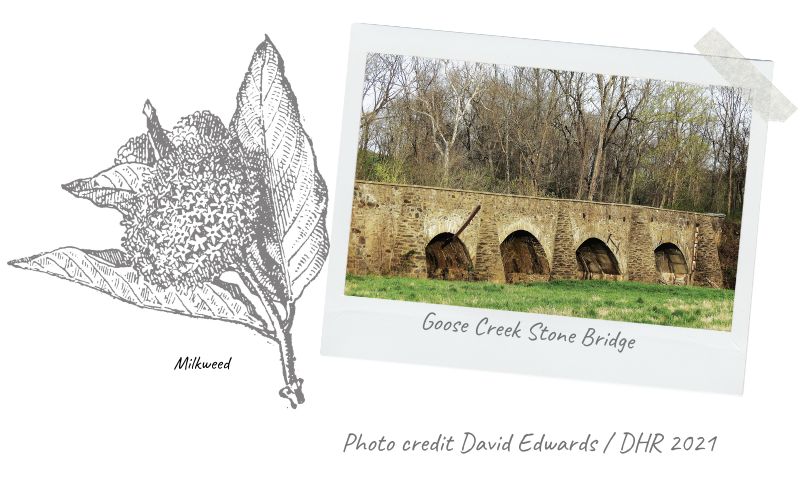
The Goose Creek Stone Bridge area is an important asset to the community — a popular tourist attraction and rest stop, picnic area, event location, and study site for conservation and environmental studies. It is a featured stop on the Civil War Trail and is an important location for historic tours and reenactments.
The club has held numerous fundraising campaigns to support the bridge and has successfully applied for grants, including a Federal ISTEA grant, to repair the bridge and to establish a road and viewing area, with information signs, for people and cars.
After years of caring for the bridge, the club passed its responsibility to the Aerican Battlefield Trust and NOVA Parks.
The club supports numerous like-minded organizations in community projects: the garden at the Middleburg Library; Nature Camp scholarships; Garden Club of America projects; Middleburg Beautification and Preservation Association; Upperville Garden Club Roadside Planting and Traffic Calming Project; and Middleburg Garden Club Post Office front border planting project.
The club established a Grants and Projects Committee in 2018, with the joint objectives of determining how much the club could spend on philanthropic support for the community and on researching requests for grants and proposals. Recent club projects include: sponsoring a horticultural intern (a 2018 graduate of Oberlin College majoring in environmental studies) at Blandy Experimental Farm, the State Arboretum of Virginia; funding the establishment of a vegetable garden at Claude Moore Elementary School in Rectortown, enabling the school to purchase needed tools, soil amendments, and a small storage shed; beginning work on an Interpretive Plant Trail adjacent to Mt. Zion Church and along a part of the few remaining portions of the Old Carolina Road, once the main north-south route for native tribes and early settlers; distributing Christmas gifts at local senior citizens’ homes; and contributing funds for planting trees in the healing garden of Boulder Crest. The club was honored to receive the 2017 GCV Common Wealth Award for Boulder Crest.
Middleburg Horticulture Symposium and Fundraising
Since the early 1990s, Fauquier and Loudoun Garden Club’s primary fundraiser is its biennial Middleburg Horticulture Symposium. The sell-out event is open to the public and includes morning coffee, outstanding speakers, a box lunch, and a good selection of garden-related vendors who share profits from sales of plants, books, garden accessories, botanical prints, etc. with the club. Speakers, often authors, offer their books for sale.
Speakers, to name a few, have included Renny Reynolds, Chip Calloway, Patrick Chasse, Pamela Harper, Dan Hinkley, Ken Druse, Gordon Hayward, and Robin Parer.
At the request of the family of deceased FLGC member Linda Newton, the club held a sale of gardening items and books from her estate and raised enough to fully fund two Nature Camp scholarships in 2019 and 2020.
Club Programs and Activities
FLGC members have a broad range of interests: participation in GCV flower shows and regional daffodil shows; leadership roles in GCV, GCA, and the American Horticultural Society; world-class gardening, extensive gardens travels, and garden photography; historic preservation; and conservation. An excellent newsletter and website keep members involved and connected — the key to a productive, cohesive club. Monthly programs have provided educational opportunities with speakers, workshops, field trips, and demonstrations.
Speakers and topics have included Landscaping Small Spaces with Jane MacLeish; artist Antonia Walker with Impact of Color in the Garden; Anne Donnell Smith with Conversation about Daffodils; Sally Bolton with Organic Farming, providing tips to encourage good bugs, breathe new life into bad soil, and stay green; George Thompson and Kathy Marmet, founders of the American Chestnut Society, discussing the restoration of the American chestnut tree; Adele Chatfield-Taylor, president of the American Academy in Rome; Joe Coleman, president of Loudoun Wildlife Conservancy; Patowmack Gardens owner on Organic Vegetable Farming; landscape architect Larry Weaner, who specializes in meadows; Jennie DuPont of The Garden Conservancy; and Elizabeth Norman on French garden history. Doug Tallamy and Jeff Wolinsky have inspired members to learn about native plantings and meadow restoration.
GCV President Nina Mustard spoke on the history of FLGC, providing a superb introduction to new members and educating some of the older hands about club activities over the century of our club’s existence.
Annual club themes have added interest and participation in monthly meetings. A particularly interesting theme featured the area’s history and each meeting was held in a historic building — Aldie Mill, Armistead House, Buchanan Hall, the Caleb Rector House, Dodona Manor, Goose Creek Stone Bridge, Oak Hill, Oatlands, and The Plains Depot. In addition to the featured program, a brief history of the building was shared with members.
The club’s interest in flower arranging has been reflected in numerous programs, and monthly artistic arrangements concentrate on the elements and principles of design. One popular program featured member Margaret Kincheloe, who was prepared with colorful baskets of flowers and with amusing commentary. She demonstrated how to condition, set up the mechanics, begin the arrangement, and finish it as a helpful guide to arrangements for members to enter in flower shows or to use in our home settings. A mock flower show was held using photos of actual entries in shows, preceded by what judges look for, followed by our own members judging, and then hearing the actual winners and why they were chosen. Speakers have included Annie Vanderwarker with Fearless Flower Arranging, floral designer Holly Heider Chapple, and Matilda and John Bradshaw on their winning floral designs and mechanics.
Hands-on workshops have been popular. Member Kay Shiflett held a propagation workshop, FLGC Program Chairman Aline Day held a workshop to create hypertufa pots, James River Garden Club member Peyton Wells held a botanical arts workshop, and the club held a horticulture workshop for new and provisional members..
Being a member of the Garden Club of America FLGC club meetings often include preparations for zone meetings and participation in GCA events.
Garden and farm tours and field trips have always been popular. Members have enjoyed visiting Mary Lou Seilheimer’s garden, Donna Hackman’s garden, gardens around Richmond and Washington, D.C., Blandy Experimental Farm at the Virginia State Arboretum, Longwood Gardens, Winchester Farms, and Abrams Creek Wetlands in Winchester, followed by a meeting and lunch at the Museum of the Shenandoah Valley. The meeting at Blandy Experimental Farm provided an opportunity to showcase the GCV’s restoration work along Dogwood Lane and to recognize the club’s long association with Blandy and the Virginia Native Plant Society. Sally Anderson led members on a guided walk along the Native Plant Trail. The club visited another GCV restoration site, Green Spring Gardens, in Fairfax County.
Conservation Interests
FLGC members are actively associated with organizations that protect open space; fight billboards; protect the landscape from unsightly power lines; preserve historic sites; educate the public, especially school children, about the history of the area; and preserve clean air and water.
2015 – 2016 GCV Lily Show and Horticulture Show
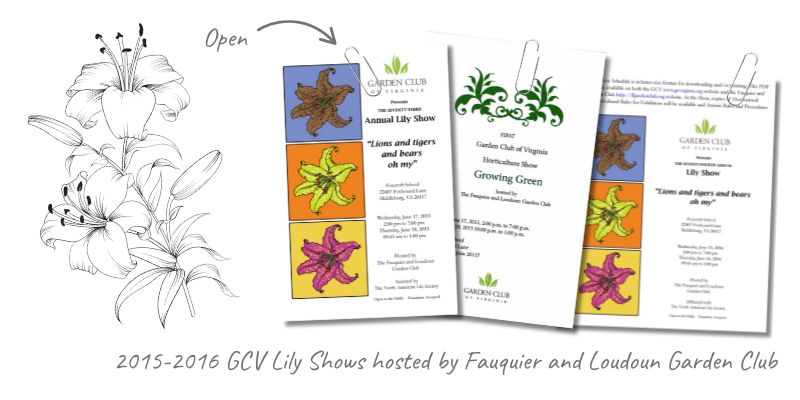
Fauquier and Loudoun Garden Club hosted the 2015 and 2016 GCVl Lily Shows in Middleburg at Foxcroft School, co-chaired by Lucy Rhame and Elaine Burden. For the first time, the horticulture and divisions shared the space with a judged general horticulture show, Growing Green, and an artistic design class that did not require lilies.
FLGC Presidents 1996-2020
| 1996-1998 | Mary Howe diZerega |
| 1998-2000 | Daphne Cheatham |
| 2000-2002 | Elaine Burden |
| 2002-2004 | Di Cook |
| 2004-2006 | Linda Newton |
| 2006-2008 | Ginger Wallach |
| 2008-2010 | Kassie Kingsley |
| 2010-2012 | Missy Janes |
| 2012-2014 | Kay Nazarian |
| 2014-2016 | Harriett Condon |
| 2016-2018 | Aline Day |
| 2018-2020 | Christine Smith |
“The Garden Club of Virginia exists to celebrate the beauty of the land, to conserve the gifts of nature and to challenge future generations to build on this heritage.”
These worthy goals have guided the Garden Club of Virginia since 1920.
> Learn More
© 2008-2026 The Garden Club of Virginia. All Rights Reserved