

Albemarle Garden Club
March 21, 2022
Editor’s Note: The following Albemarle Garden Club history was written by AGC member Christine McNeely.
The Follow the Green Arrow III history of Albemarle Garden Club from 1995 to present coincided with the arrival of the Information Age. Like a tree with a strong core, our club withstood the stresses of adapting to new technology and changing conditions. Advocacy and educational opportunities expanded. Communication and connectedness flourished. Our legacy endures thanks to careful consideration in all we do and our strong affiliation with the Garden Club of Virginia.
1995 – 2008 A Time of Distinctive Growth: Collaboration, Education, Beautification, and a 90th Birthday Celebration
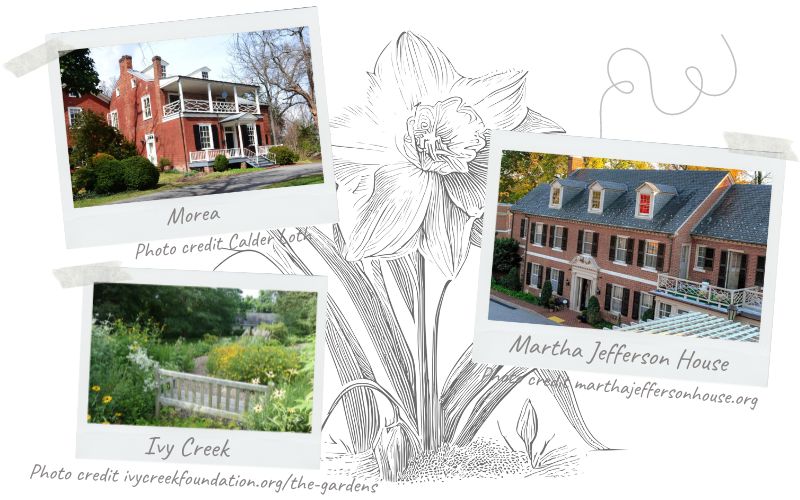
During the 1990s invitations and the newsletter were sent by postal service and phone calls delivered news and announcements. Garden workdays were billed as Ivy Pulls and Weed Ins at Morea, a historic property at the University of Virginia, and Martha Jefferson House, a local retirement home. Ivy Creek cleanups were on the activity calendar annually. Daffodil bulbs were planted at Gordon Avenue Library and along the sidewalk of Preston Avenue beside the newly renovated Booker T. Washington Park.
A five-year commitment to create and maintain a meditative grove at the Kluge Children’s Rehabilitation Center commenced. Additionally, the Civic Projects Committee gave time and money to design and plant around JABA (Jefferson Area Board for Aging) and purchased greenhouse heaters for the Charlottesville-Albemarle Technical Education Center. Other local charities that benefited from our members’ time, talent, and funding for plantings were the Educational Center at the Miller School and Blue Ridge House (now renamed Blue Ridge Center), which provides access to mental health services. Every December, members would arrive at the Christmas Workshop in festive attire with a small bedside arrangement made in an empty painted tuna fish can, as was tradition. They came ready to roll up sweater sleeves and create, on average, 70 table arrangements and 45 wreaths for nursing home and hospital patients.

Bonds between members were strengthened through activities of the Time and Talents Committee, and by way of field trips and organized advocacy. The tradition of making floral arrangements for a member’s family wedding endured through a shared sense of joy in this long-standing club fundraiser. A future committee – Share Your Joy – would take root in the soil of Time and Talents. The Philadelphia Flower show was an annual destination for some members, and visits to plant centers and public and private gardens were annual field trips closer to home.
In response to environmental concerns of the moment, the Conservation Committee kept the watershed of the Rivanna reservoir simmering on the front burner and advanced GCV’s conservation agenda through editorials and letters to representatives. Calls and appointments were made to speak to local officials and county boards to oppose a proposed Route 29 Bypass and, instead, support the redesignation of Route 250 West as a scenic highway. Members wrote and phoned legislators to ultimately help defeat the tremendously powerful billboard industry. Save Goshen Pass, smokestack mercury emissions, public drinking water supplies, Virginia offshore oil drilling, and even the Arctic polar bears garnered AGC attention. Take the Bus to Lobby Day for the Bay was a favorite memory of group effort. Our role as citizen activists continues today to enrich root systems throughout the commonwealth.

In the early 2000s, AGC adapted to a computer-generated newsletter, Com.post, a bulletin emailed monthly, featuring news and relevant gardening information. One newsletter editor wrote, “Please, ladies – get your additions to me by the last day of the month! I simply could not CALL everyone each month for news. Thank you!” The bulletin featured a president’s message and a column for “Blue Ribbons” to acknowledge in writing a member’s good work, cooperation, accomplishments, etc. Monthly tips from the Horticulture and Conservation Committees were included and, sometimes, the occasional recipe request. In time, limbs of the Telephone Committee were gently pruned to allow for growth of a Communications Chairman and committee.
In June 2001, the club hosted a Garden Club of America Small Flower Show and plant sale in the auditorium of the former Kappa Sigma National Headquarters. The show featured a special exhibit in the schedule for conservation education, an Ecology Box, initiated by the Garden Club of Virginia. Our club served as a pilot in the design and execution of this learning box, which was a teaching aide for children in the elementary grades on how to care for and protect the environment and to conserve and protect its resources.
In September 2003, AGC celebrated 90 years with a cocktail party at the Greencroft Club for a 91 member-strong club! A beautiful photograph featuring many past presidents in attendance accompanied an article published by the Daily Progress and, our historian, Mary Pollock, published a detailed history in the GCV Bulletin.
We initiated casual Garden Walks at member homes and expanded monthly programs to often include casual flower shows. One example was in September 2002, when members brought arrangements for a Show and Tell theme: Survivors of the Drought. Sometimes meeting program themes were in the form of questions such as, “How do I find new perennials for shade?” or “How do I have fun?” for a cocktail party invitation the same year. The desire for more frequent workshops gained momentum in horticulture propagation, floral design techniques and photography skills. Preparation for and participation in GCV’s lily, rose and daffodil shows proved successful and provided inspiration for future mainstay events.
Tri-Club activities have strengthened our commitment to GCV and relations with our sister club members. In the early 2000s, AGC achieved an important milestone for Historic Garden Week by forming a Tri-Club Committee with the Charlottesville and Rivanna garden clubs to share responsibilities in hostess duties and collaborate in property procurement. Years later, the Tri-Club Committee would begin to host a membership meeting for the three clubs in January on the off-year of a GCV President meeting. The first off-year meeting featured Tanya Denckla Cobb, author and director of the Institute for Engagement & Negotiation and a mentor at the Institute for Environmental Negotiation at UVA. A favorite tradition of current and past presidents of the three clubs is decorating Charlottesville’s Amtrak Station at Christmas. AGC former president, Katya Spicuzza, conceived of this joint effort after several years of spreading holiday cheer on her own beginning in the early 2000s.
Civic Projects: Our Community Legacy
Since the 1997 renovation of Booker T. Washington Park (BTWP), an urban piece of land donated to the City of Charlottesville in 1926 for the first black public park, the Civic Projects Committee had given much consideration to how AGC might best serve the park. AGC’s leadership, including planting and beautification efforts around the BTWP from 1997-2003, provided a platform from which the city officially launched the Bog Garden and AGC’s association in October 2003. The new garden featured a constructed boardwalk donated by Virginia Power, though very few plants. AGC would go on to receive the Garden Club of Virginia’s Bessie Bocock Carter Conservation Award in 2014 for “Interpreting the Bog Garden – Where Conservation, Horticulture and Civic Projects Meet,” to enhance the beauty and wildlife habitat of a city park wetland.
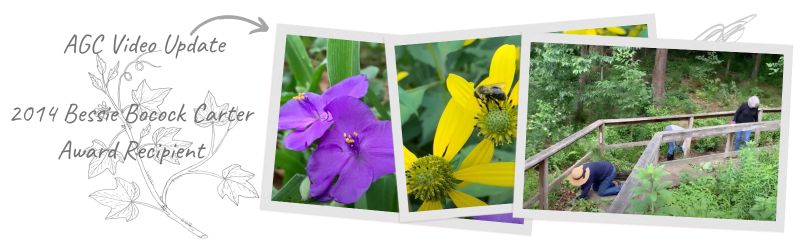
In the years since, the Bog Garden has become our signature civic project with funding from the Garden Club of America and from the proceeds from AGC fundraising events, specifically the Design Forums. This urban wetland is replete with a large-scale functional pollinator hotel, more than 1,000 native specimens, and is used as an event site for our community engagement efforts. Local schools use the Bog Garden to teach science lessons and local nonprofits utilize the wetland garden for outdoor educational programs. Most recently, AGC has partnered with the City of Charlottesville and other organizations to rebuild a set of access stairs, added benches and holds monthly workdays to scan the area of invasive plants.
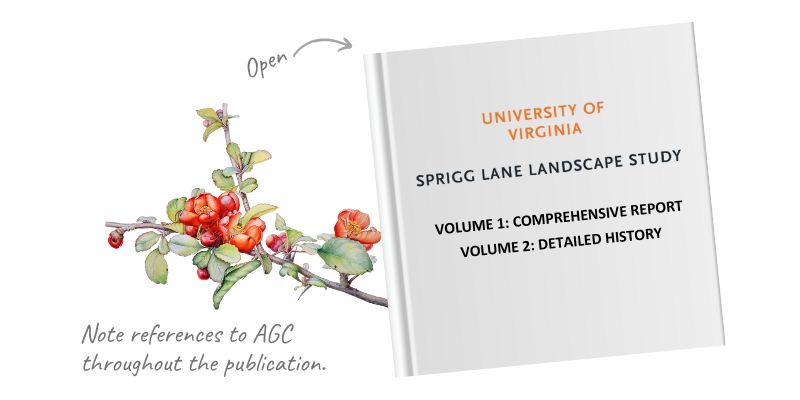
Morea: A Living Botanical Classroom is a special gem on grounds at the University of Virginia and also in the hearts of many members. The house at Morea was built c. 1835 by the University’s first professor of natural history, John Patten Emmet, who planted and experimented with rare trees and plants. Currently reduced in size, the property retains a few trees which may date from his occupancy. Our commitment to planting and maintaining the Morea garden in coordination with the University began in 1962, when AGC established the Albemarle Botanical Collection there to show examples of attractive plants suitable for local landscapes. Over many years AGC has spearheaded creation of professional landscape designs, paid for planting new trees and shrubs and, until a few years ago, held several workdays each year to help with maintenance. Eighty-five varieties of plants are featured. In 2006, AGC was honored to receive the Garden Club of Virginia’s second place Common Wealth Award, which enabled restoring plantings on the northeast border, permanent signage installation, and adding a new bench. In 2016, AGC paid for creation of an updated existing conditions plan of the Morea landscape, noting the location and names of plants, which it donated to the University. As the University has grown and the house is now used as a faculty residence, AGC has turned over maintenance to its professional staff but remains “on call” should the University desire additional help with new plantings or other needs.
In 2006, AGC took a lead role, along with the Charlottesville and Rivanna garden clubs, in the landscape renewal of a landmark central to our city’s black heritage: the historic renovation of the Charles B. Holt house. Mr. Holt was a son of a North Carolina slave, a carpenter, owned his business and built his dream house in 1926, which overlooks Booker T. Washington Park. AGC committed money and time to ensure successful landscape completion of the Rock House. Prior to renovation, the house fell in disrepair while being used as a storage building for two decades. Current owners use the beautiful bungalow for legal aid housing and support. In 2007, upon dedication of the restored home, The Daily Progress featured an article: “Rock House Reborn: Jim Crow Era House Feted.”

City Schoolyard Garden, an organization which launched vegetable gardens as teaching aids in city elementary schools, was a club favorite for many years through an annual Civic Projects Committee donation, as well as club members volunteer work with students. Around the mid-2000s AGC engaged in the creation of a rain garden and a viewing spot along a trail at Mint Springs Valley Park in Crozet. This commitment lasted several years in conjunction with Henley Middle School and highlighted the importance of water conservation. Later in the decade, the Southwood Mobile Home Park was the site of another important AGC project. We contributed plants and labor for landscape beautification of the Boys & Girls Club at the Southwood Community Center soon after Habitat for Humanity acquired the property for eventual redevelopment into better lower income housing.
The Conservation Committee continued promotion of environmental concerns through support of the Scenic Highways Program and the Adopt-A-Stream cleanups focused on Ivy Creek at Barracks Road and Old Garth Road. Emphasis on attendance at public hearings on historic preservation plans, cell phone towers and power plant installations provided platforms to share our knowledge in a community setting.
What was the brainchild of our Conservation Committee in 2006 has become an AGC signature community fundraiser for Community Projects. The inaugural AGC Design Forum featured design legends David Easton, George Carter and Xa Tollemache as speakers to a sellout crowd at Farmington Country Club. Ever since the May 2, 2006, Design Forum, events featuring world-renowned leaders in the areas of design, history, horticulture, gardening and flower arranging have been staged regularly. Past speakers include Bunny Williams, Richard Guy Wilson, Renny Reynolds and Jack Staub of Hortulus Farms, Charlotte Moss, Meryl Gordon, Sir Peter Crane and Mark D. Sikes. Design Forum Film presented a documentary film by Thomas Piper – Five Seasons: The Gardens of Piet Oudolf.
AGC joined the Bicentennial Birthday Celebration of America’s premier landscape architect and presented, in partnership with the University of Virginia’s Center for Cultural Landscapes, Olmsted Forum: Olmsted in the Field: “Landscape Travels and Design Practices.” The event, held September 14-15, 2021, focused on the relevance of Olmsted’s legacy in the park movement today, which featured Olmsted scholars and practitioners. This Design Forum also featured a virtual flower show: Genius of Place: An Ode to Frederick Law Olmsted.
Finances and Additional Fundraising
The Finance Committee, in 2006, began a new protocol of publishing the annual projected budget summary in the monthly newsletter. During the early 2000s, bookkeeping was moved to online accounting software and our successful fundraising necessitated the filing of our first nonprofit organization returns with the IRS, which we have filed every year since. Growth brought the need for more careful administration and attention to legal requirements.
Following our long-standing tradition of raising club funds through flower arrangements for members’ family weddings, the Fundraising Committee pivoted to the sale of pansy plants, which quickly became a blue ribbon, once-a-year source of funds. Around the same time, other popular fundraising came in the form of Kroger Cares cards and members’ donations to the Eternal Attic, a local consignment boutique, which gave sale proceeds back to our club.
2008 – 2015: Garden Club of Virginia Board of Governors Meeting and AGC Centennial Celebrations
More AGC members began filling roles at The Garden Club of Virginia during these years, with five members involved at the state level in 2011 alone. This strengthened understanding of the needs and workings of the statewide organization and fostered many enduring friendships across Virginia.
In 2008, many members attended the first ever Garden Club of Virginia Symposium in Fredericksburg, which was the site of GCV’s first restoration project.
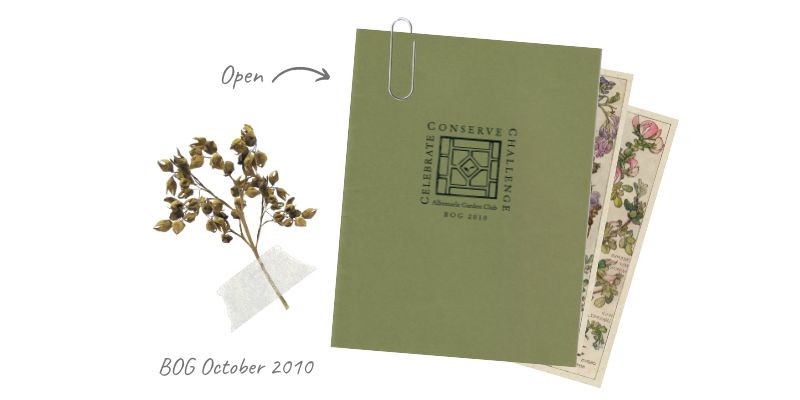
Two years later, AGC hosted the 2010 Garden Club of Virginia Board of Governors meeting, Celebrate, Conserve and Challenge, in downtown Charlottesville at the Omni Hotel. Optional activities included tours to see new garden spaces at Monticello, the University, and a self-guided tour of the downtown mall. A luncheon was held at Carr’s Hill, home to the University president.
Centennial 2013
In honor of its centennial, AGC instituted a $5,000 research grant for several years to fund graduate scholars in fields consistent with the club’s mission. It was a great year! Celebratory events included: Return to Morven, Birthplace of AGC. Our members gathered for a kick-off meeting at Morven and many dressed in 1913 attire; A Bouquet of AGC Ladies, a club flower show inspired by and dedicated to members past and emerita who have made our club vibrant and strong; and A History of AGC talk with slideshow at the Small Collections Library (home of AGC archives) given by our much admired and long serving club historian Mary Pollock. Following the slideshow, Mary presented to each club member a copy of her newly printed book: The Seeds of Time, the First Hundred Years of the Albemarle Garden Club. The book is dedicated to gardeners who came first and those who will come afterwards….
Centennial Chairman Candy Crosby wrote a forward, included below:
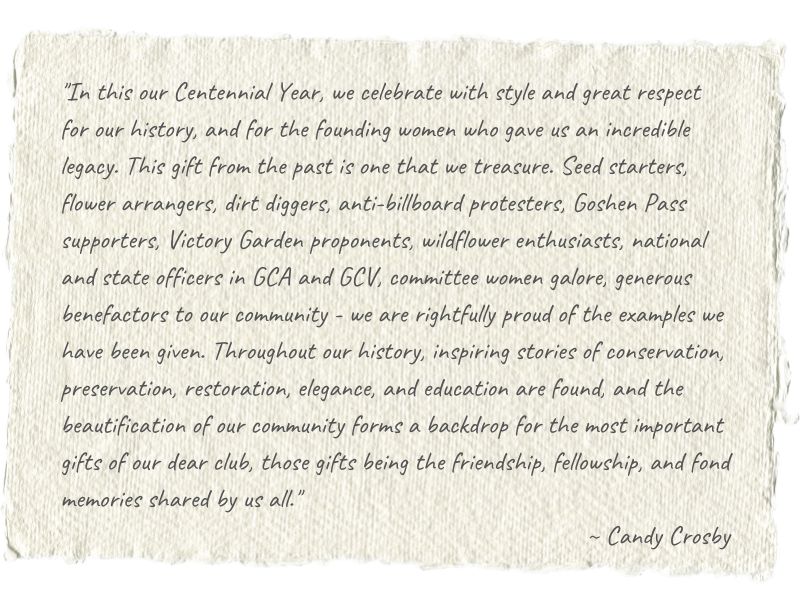
Mrs. James Gordon Smith of “Casa Maria,” Greenwood, served as President of Albemarle Garden Club and the Garden Club of Virginia. In 1963, she was awarded the GCV’s most prestigious award, the Massie Medal. An excerpt from her citation reads: “…guardian of Virginia’s natural resources and beauty, restorer of the glories of the past, exemplar of a gentle tradition of service.” Surely there is a bit of those qualities in all of our members today. As we are inspired by our past, so do we provide examples for our future. Imagine, if you will, the year 2113, our bicentennial year. Will future members be amazed by the gardens we’ve made or restored, and the landscapes we’ve preserved? Will they be astounded by the limitless energy and hours we’ve spent on our club activities at local, state, and national levels, and all we’ve accomplished? I have no doubt that the answer is “YES!” and gratitude fills my heart. Thanks to each one of you, for building on the past and continuing our tradition of service and caring. Long may we reign!
2015 – Present: New Endeavors, Flower Shows and a Pandemic
Through meetings, programs and events our membership began to highlight conservation through a focus on waste reduction. Members brought coffee mugs and water bottles to meetings, eschewed printed materials, replaced oasis with chicken wire and, through the addition of two new initiatives, our members walked the talk on conservation. Rescued and repurposed greens and flowers from workshops and flower shows were the springboard for a new initiative, the Flower Flash, through which we honored health care heroes at local hospitals, lifted hearts of sick children and their families and brought pride to our community spreading buckets of joy! Share Your Joy, another new initiative and club committee, became an instant member favorite. Members gather Sundays at Tourterelle, a floral design studio, that partners with AGC to give new purpose to leftover wedding flowers. Floral arrangements are then donated to local hospitals or other charities.
Flower Shows and Workshops
Our membership is fortunate to include approved judges in the disciplines of floral design, horticulture and photography through the Garden Club of Virginia, the American Daffodil Society, and the Garden Club of America. GCV even created a photography award in honor of one member, Claire Smithers Mellinger. Our judges are excellent teachers. Frequent workshops encourage success through all components of the flower show process: from help with writing show schedules to identifying and grooming specimens on show day. Always fun and educational, a few recent in-club show include: Daffodils Dancing in the Breeze; It’s a Daffodil Party; March Madness; Beautiful; In Time of Daffodils.
Another way we gather for fun and fellowship is through Right Out Our Back Door, a scheduled monthly opportunity to gather with our AGC friends for a walk or hike in nearby areas or to visit interesting gardens and landscapes in beautiful central Virginia.
A new Sustainers Committee was formed around 2015 to keep longtime members connected to the club and each other. The committee organizes a casual annual luncheon for all Sustainers and Emerita and gets together at Christmas by preparing and delivering gift boxes of homemade cookies or another special treat. The committee recently revived a practice started by the late Jane Heyward, a skilled gardener, who used to arrive at meetings with a sprig of something plucked from her garden as a “show and tell.” Today, this “Jane Moment” is a feature at our meetings with Sustainers taking turns bringing a snip of a favorite plant to describe.
Pandemic
Our intrepid club leaders devised meetings, programs and workshops to continue in light of considerable global uncertainty. We had the good fortune of virtual programming for our members. These special occasions included many speakers from whom we otherwise would not have had the opportunity to learn. We became tech savvy through Zoom meetings and webinars and our first virtual flower show. When possible, we gathered outside with lots of social distance. Our Photography Committee documented this historic period by creating a lovely slideshow from photos captured of members and their loved ones at their homes.
AGC Awards
AGC Presidents 1995-2021
| 1995-1997 | Becca Pettygrove |
| 1997-1999 | Poochie Wallenborn |
| 1999-2001 | Linda Ford |
| 2001-2003 | Katya Spicuzza |
| 2003-2005 | Kathi Marshall |
| 2005-2007 | Julie Stamm |
| 2007-2009 | Trina English |
| 2009-2011 | Candy Crosby |
| 2011-2013 | Brooke Spencer |
| 2013-2015 | Kim Cory |
| 2015-2017 | Carol Carter |
| 2017-2019 | Clair Mellinger |
| 2019-2021 | Esther Hannon |
“The Garden Club of Virginia exists to celebrate the beauty of the land, to conserve the gifts of nature and to challenge future generations to build on this heritage.”
These worthy goals have guided the Garden Club of Virginia since 1920.
> Learn More
© 2008-2026 The Garden Club of Virginia. All Rights Reserved