

Restoration and Research Fellowships
January 17, 2023
Chairman Kim Nash, The Warrenton Garden Club
Restoration Committee visits during the summer and fall of 2014 included Oatlands in Leesburg, John Handley High School in Winchester, Burwell-Morgan Mill and the Virginia State Arboretum’s Dogwood Lane in Clarke County and Belle Grove in Middletown.
Work continued on the Historic Henry County Courthouse project in Martinsville, the Beatrix Farrand-inspired garden at Green Spring Gardens in Fairfax County, Poplar Forest near Lynchburg and the Kitchen Road portion of the Mountaintop Project at Monticello. Chairman Kim Nash reported, “At the behest of the Cultural Landscape Foundation, known as ‘the nation’s largest and most valuable nonprofit source of information about our nation’s historic landscape’ GCV members will welcome visitors to the Kent-Valentine House during the foundation’s What’s Out There Weekend Richmond on Saturday, October 25. GCV Restoration work is featured in the newly conceived Richmond Garden Trail. Along with well-known Lewis Ginter and Maymont, the Enchanted Garden at the Poe Museum is included on the list of eight sites and is described as a ‘hidden gem.’”
GCV Landscape Architect Will Rieley was authorized to draw up a conceptual plan for the restoration of the East Garden at Stratford Hall, the first step towards a rewarding renewal of the long-standing relationship between the GCV and the Robert E. Lee Memorial Association.
Work continued throughout the winter and spring of 2015 on the Historic Henry County Courthouse, the dignified centerpiece of Martinsville’s uptown. Kim reported, “The Garden Club of Virginia has worked closely with the City of Martinsville and the Martinsville-Henry County Historical Society to enhance the surrounding plaza, and the Martinsville Garden Club and the Garden Study Club smoothed out any number of bumps on the way to the finish line. Now Martinsville’s residents will be able to enjoy a welcoming, revitalized community space.”
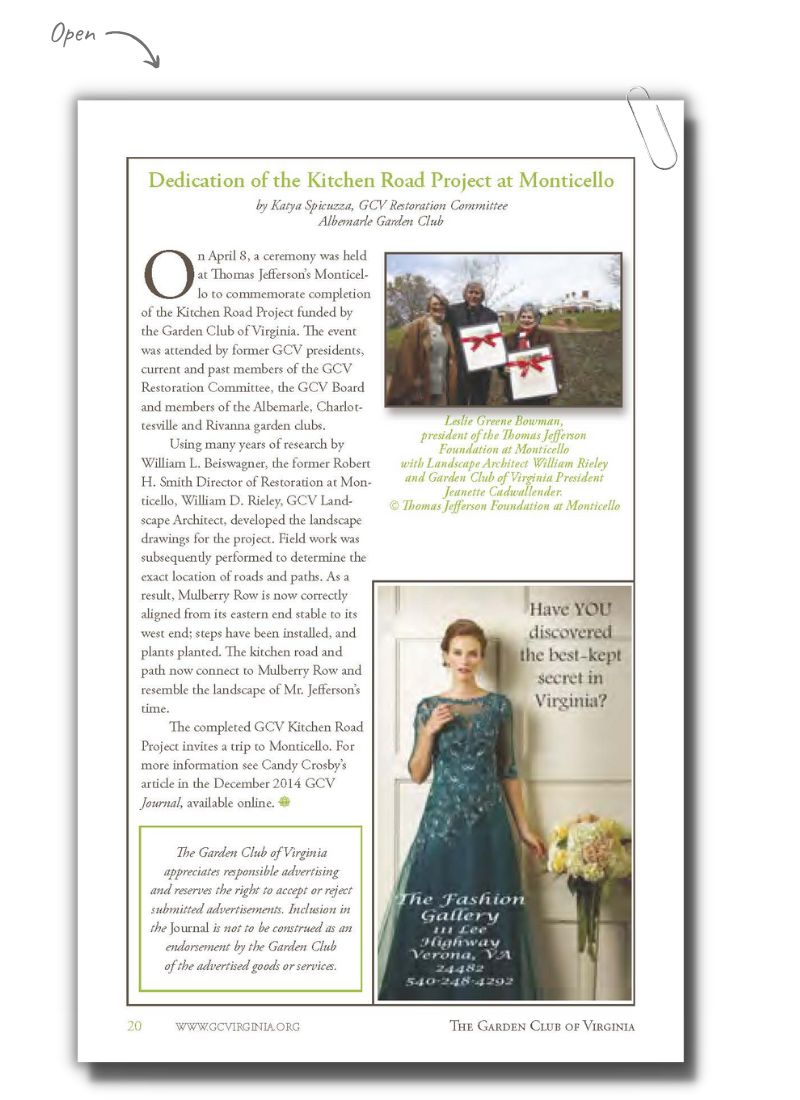
The Mountaintop Project at Monticello was nearing completion when the committee visited the project in March, reporting that the recreated Kitchen Road “will burnish the GCV reputation in any number of academic and horticultural circles.”
Kim added, “Workers at Poplar Forest continue to uncover significant clues about Mr. Jefferson’s unique landscape at his retreat, and Mr. Rieley continues to put those pieces of the puzzle in place. In addition to the expected high standards of workmanship associated with any project undertaken by the Garden Club of Virginia, Poplar Forest has benefitted by Mr. Rieley’s profoundly scholarly research which has informed our work there.”
Work continued at the Enchanted Garden of the Poe Museum where its design and plantings were created to enable visitors to reflect on the work of Edgar Allan Poe.
Lastly, at the request of the Clarke County Historical Society, the committee agreed to revisit the Burrell-Morgan Mill in Clarke County to rework the design of the forecourt to alleviate severe drainage issues.
Summer and fall 2015 committee visits included Mount Vernon, the Beatrix Farrand Garden at Green Spring, Kenmore, the Mary Washington House and the Mary Washington Monument in Fredericksburg and Stratford Hall on the Northern Neck.
The Garden Club of Virginia presented the Beatrix Farrand Garden at Historic Green Spring to the Fairfax County Park Authority in Fairfax on June 10. Kim described the event, “Rieley and Associates has brought back to life the only documented garden in Virginia designed by Beatrix Farrand, the only female founding member of the American Society of Landscape Architects. This 1942 garden is a wonderful example of her country place residential design and its half-acre is an important component within the larger public park which showcases a wide range of gardening styles, demonstration gardens and naturalized areas.” She added, “The 640 different kinds of plants in the perennial border reflect the fondness of the autodidactic designer for the Impressionist palette.” Among the 80+ guests were county officials, as well as GCV members from Fairfax, Hunting Creek and Alexandria garden club. Photos
Immediately following the 2015 fall Board of Governors, the Garden Club of Virginia presented the restoration of the grounds of the Historic Henry County Courthouse.
The Restoration Committee approved a plan to replace a pathway at Oatlands and to repair the structures privy and well house in the Mary Washington House Garden. Work was nearing completion on the Eastern Shore to refurbish the entrance apron and walkways at Ker Place, a 200-year-old Federal dwelling.
Plans were underway in Clarke County to renovate the entrance court of the Burwell-Morgan Mill.
The Low Country Garden at the Poe Museum in Richmond was completed. The garden, inspired by the author’s story, The Gold Bug, which is set on Sullivan’s Island and on the mainland near Charleston, features banana shrubs and Sago and Needle Palms.
Poplar Forest continued to present challenges when the restoration of the carriage turnaround posed questions of authenticity versus the current standards of safety and accessibility.
The Kitchen Road Project at Monticello was all but finished.
Kim announced the approval of a new project at Lynchburg’s Point of Honor. The Restoration Committee had been approached earlier by the Lynchburg Museum about renovating the existing garden behind the house that was designed by Rudy Favretti, independently of the Garden Club of Virginia. Maintenance funding and staff had been greatly reduced, rendering upkeep of the area untenable. At the direction of the Restoration Committee, and working with the buseum board, Mr. Rieley drew a conceptual plan for a garden appropriate to the period, which will be much easier to manage and allow for event use.
Restoration Committee visits in the winter and spring of 2016 included St. John’s Mews and the Poe Museum in Richmond, Ker Place on the Eastern Shore, Historic Portsmouth Courthouse and the Moses Myers House in Norfolk.
In response to a request from the Director of Virginia’s Executive Mansion, the Restoration Committee authorized Mr. Rieley to design a simple, welcoming garden to include commemorative information celebrating those who lived there and worked at the mansion during the governorship of David Campbell of Abingdon (1837-1840). It was called the Valentine-Jackson Garden after letters written to family back in home Southwest Virginia by Valentine and Jackson, two enslaved residents, were discovered. Mr. Rieley’s reinterpretation of an original Gillette plan was a special gift from the Garden Club of Virginia. The work was carried out by the staff at the Executive Mansion, and the Restoration Committee was not responsible for its oversight.
On April 8, 2016, the Garden Club of Virginia presented the restored Kitchen Road at Monticello.
In January of 2016, Kim reported to the Board of Directors that she sent a letter to Historic St. Luke’s, expressing dismay over the years of disregard for its obligation to preserve the work done by the Garden Club of Virginia. She noted that a delegation from the Restoration Committee would meet with the new president of Historic St. Luke’s later in the winter in hopes of finding solutions. A cordial meeting with St. Luke’s administration on March 9 made it clear to both parties that GCV expectations and Historic St. Luke’s plans for future development of the property had diverged beyond any hope of realignment. Historic St. Luke’s president David Hare stressed that HSL harbors no ill will towards the GCV, but rather is appreciative of the work done there and will continue to be supportive of the local clubs. The Restoration Committee resolved at its March meeting to recommend that Historic Saint Luke’s be withdrawn from its portfolio of active Restoration properties.
The GCV Board of Directors voted to release Historic Saint Luke’s from its obligations, stating that GCV was honored to work with the property to create park-like setting to protect the nation’s only surviving original Gothic building from the encroachment of the 21st century. Historic Saint Luke’s administration assured GCV that they would continue to support the local GCV clubs as they assume full responsibility for the stewardship of this important site.
Boxwood Blight
In early 2015, the boxwood in the Bowknot Garden at the Woodrow Wilson Presidential Library began to decline dramatically and tests for boxwood blight (Cylindrocladium, buxicola or Calonectria pseudonaviculata) came back positive. Numerous efforts to stop the decline throughout the summer and fall were unsuccessful, and the garden was closed to the public in October 2015. After reviewing suggested remedies, the Restoration Committee voted in January 2016 to recommend the removal of all the boxwood at WWPL, contingent upon agreement by the owners of the property. The Restoration Committee set aside funds to cover the removal.
The committee felt at this point it was imperative that information about boxwood blight be disseminated to a wide audience throughout the Commonwealth. Sue Thompson wrote an article for the March 2016 Journal, to be distributed to club presidents for discussion among the entire membership. Realizing the spread of boxwood blight has tremendous ramifications not only for classic garden design in Virginia, but also for Historic Garden Week, the Restoration Committee urged the Garden Club of Virginia to stand on the front lines of efforts to contain this highly contagious fungus. Read Best Management Practices for Boxwood Blight.
Research Fellowships
View Fellowship Research Archives
The 2015 Rudy J. Favretti Fellowship was awarded to Wenling Li, graduate of the Master of Landscape Architecture program at Harvard University. Her research site was Berkeley Plantation in Charles City County. The William D. Rieley Fellowship was awarded to Amanda Goodman, a student in the Master of Landscape Architecture program in Urban & Environmental Planning at the University of Virginia. Her research site was Westover Plantation adjacent to Berkeley Plantation in Charles City County.
On Friday, August 21, 2015, both fellows presented the results of their summer research to a gathering of about 50 GCV members and other interested individuals at Berkeley Plantation. After a welcome greeting by Mr. Jamieson, owner of Berkeley, and his daughter, Cary, Mr. Rieley introduced Wenling Li. With a well-designed PowerPoint presentation, she gave an overview of Berkeley. The landscape provides a dramatic vista through boxwood gardens, across five expansive, grassed terraces toward a James River entry known as Harrison’s Landing, celebrated as the site of the first Thanksgiving. Wenling discovered documents previously unknown to the property and produced important geometric assessments of the landscape.
Amanda’s presentation of Westover focused on how the grounds and gardens evolved, not from a formal master plan but as planting progressed over time. War and the various owners who succeeded the William Byrd family (I, II — founder of the city of Richmond — and III) wrought changes in the property, as well as the home. One significant change Amanda noted in particular was the relocation of the huge, handsome, 18th-century wrought iron entry gates. She also addressed the question of the placement of William Byrd II’s tombstone in the center of the garden.
Tours of both properties were led by the fellows and the respective property owners, Andrea Erda and Cary Jamison. We were welcomed inside the plantation homes as well as throughout the grounds.
Perhaps the most insightful observation of the day was the one made by Cary Jamieson’s five-year-old son. When asked how he felt about Berkeley, his family’s property, he responded, “If we lose it, we’ll forget our history.”
After careful consideration, the Research Fellowship Committee selected two outstanding sites for research and documentation for the 2016 program. The William D. Rieley site was Westover Plantation where research had been initiated by a 2015 fellow. The committee agreed that the wealth of material there provided potential for further research which should be continued. Eyre Hall, in Northumberland County on the Eastern Shore, was selected as the Rudy J. Favretti site.
When the committee met to evaluate applications, it was decided, as has been true in the past, that the particular strengths of the applicants did not adequately lend themselves to the needs of the properties. The material that is ultimately archived by the Garden Club of Virginia at the conclusion of each fellowship includes measure drawings, detailed documentation and historical narrative. These requirements entail a unique balance of analytical ability and creative talents.
When the Fellowships were established, it was understood that they may not be awarded each year. The committee decided that 2016 should be such a year and is focusing its attention on the Historic Research Fellowship program for 2017.
“The Garden Club of Virginia exists to celebrate the beauty of the land, to conserve the gifts of nature and to challenge future generations to build on this heritage.”
These worthy goals have guided the Garden Club of Virginia since 1920.
> Learn More
© 2008-2026 The Garden Club of Virginia. All Rights Reserved