

Restoration and Research Fellowships
November 16, 2022
Chairman Sally Guy Brown, The Alexandria Garden Club
The Restoration Committee had a busy summer in 2012 with visits to Danville, Roanoke and Lynchburg, and liaison and delegation visits to Mount Vernon, Oatlands, Woodlawn, Monticello (new gardener), Moses Myers House (new gardener), Poe Museum in Richmond, the Reynolds Estate in Critz and Blandford Church in Petersburg.
Summer and fall restoration work included tree removal at Fincastle Presbyterian Church; replanting a failed bed and planting a screen at the Beale Garden at Holllins University; replacing boxwoods at the Woodrow Wilson Presidential Library; replacing the worn-out summerhouse and arbors at the Grace Arents Garden in Richmond; maintenance at the Mary Washington House garden in Fredericksburg; Christ Church in Lancaster and Poplar Forest in Lynchburg. Poplar Forest work continued with the mulberry plantings, the clumps, and the carriage turnaround; as well as constructing new entrance gates. Digitization of records continued.
By fall of 2012, the Restoration Committee was wrapping up at the Historic Henry Country Court House in Martinsville, John Handley High School in Winchester and the Beatrix Farrand Garden at Green Spring in Fairfax County. New walkways were installed at Hampden-Sydney College’s “Birthplace” historic site, and plantings were underway.
Restoration Committee Chairman Sally Guy Brown announced approval for two new restoration projects: restoration of the Melchers’ original 1920s tree planting design on the western side of Belmont; and restoration of Jefferson’s original mountaintop roadway system and viewshed, the “Kitchen Road Project.”
Work was set to begin at the Poe Museum, and upcoming projects included the the restoration of George Washington’s wilderness plantings at Mount Vernon.
Committee member Candy Crosby chaired a successful Maintenance Workshop at the Kent-Valentine House in February, where lectures were led by Will Rieley, Jack Gary, Peggy Cornett, and Peggy Singlemann.
After careful deliberation and discussion with the National Trust in Washington, a mutual decision was made to release Woodlawn from their contract with GCV. The original GCV garden designed by Alden Hopkins had been overplanted with vegetables under their new mission to grow organic food for local restaurants and residents.
Summer and fall Restoration Committee visits included the Portsmouth Courthouse, Moses Myers House garden, and Ker Place on the Eastern Shore to see those landscapes which we have restored over the years and our recent additions to that work.
The Restoration Committee endorsed the removal of the boxwoods in the carriage turnaround at Poplar Forest.
The Garden Club of Virginia was honored by Belmont on September 29, 2013. Belmont director David Berreth applauded the work of the GCV and led attendees on a tour of the house and studio. Belmont horticulturist Beate Jenson then led a tour of the gardens. The lovely event was followed by a tented dinner at the home of Kitty Lee and Ben Wafle.
In December, the GCV was honored for their work at Poplar Forest with a reception and celebrated the plantings of the clumps for all to see just as they had been when Jefferson designed and planted them more than 200 years ago.
Chairman Sally Guy Brown reported at the 2014 Annual Meeting, “We are beginning work on the restoration of Jefferson’s original mountaintop landscape and kitchen road at Monticello. We are nearing completion of the restoration of the original Jeffersonian landscape at Poplar Forest. In December, there was a celebration of the planting of the tree clumps in the exact location that Jefferson planted them 200 years ago. We have completed the planting and restoration of the Beatrix Farrand garden at Green Spring. We have begun work on the charming garden rooms at the Edgar Allen Poe Museum in Richmond. The City of Martinsville’s portion of the Historic Henry County Courthouse project is nearing completion, and we are excited about the completion of this centerpiece project for Uptown Martinsville. These are just some of the projects we are working on.”
She then introduced Will Rieley, the official landscape architect for the Garden Club of Virginia since 1998, saying, “he has the uncanny ability to work well with more than three thousand ladies.”
Will Rieley gave an interesting PowerPoint presentation highlighting GCV work — mysteries solved by archeology, old drawings with notes and plain old deduction.
Research Fellowships
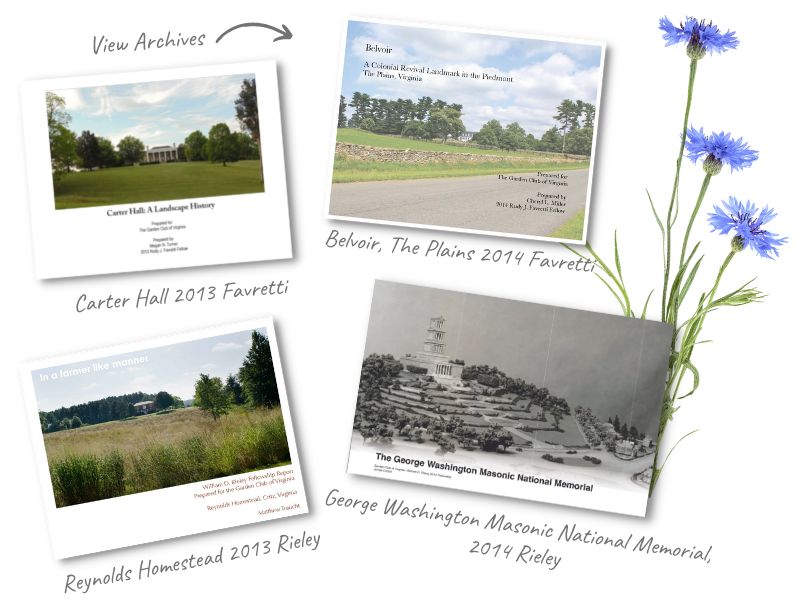
Fellowship Committee Chairman Kim Nash reported at the 2012 Board of Governors, “Our Research Fellowship program, begun by Helen Murphy 17 years ago, has blossomed into one of our most important undertakings. The Garden Club of Virginia now awards two fellowships each year to graduate students in landscape architecture. The Rudy J. Favretti Fellow researches historic gardens held in private hands within the Commonwealth. Since 2005, the William D. Rieley Fellows have been documenting historic landscapes that are open to the public.
The 2013 Rudy J. Favretti Fellow at Carter Hall in Millwood is Megan Turner. As a graduate student at the University of Georgia, Megan is working toward her Master of Landscape Architecture degree with a Certificate in Historic Landscape Preservation. Her undergraduate degree from the University of Wisconsin is in Anthropology. Ms. Turner received archaeology and environmental anthropology field training in both Sicily and the Solomon Islands. As the graduate assistant for the University of Georgia’s Cultural Landscape Lab, she comes with experience in historic Virginia landscapes via the lab’s extensive project at Stratford Hall.
Carter Hall is listed on the National Register of Historic Places and was the home of Col. Nathanial Burwell, who completed the original plantation house in 1797. Both Union and Confederate armies camped on the grounds during the Civil War and the last resident Burwell descendent sold the property to Gerald Lambert in the late 1920s. Mr. Lambert, a successful entrepreneur (best known as the Listerine King), remodeled and expanded the house and engaged the Olmsted Brothers to design a complementary formal garden.
The 2013 William D. Rieley Fellow at Reynolds Homestead in Critz is Matthew Traucht. He will be graduating from the University of Minnesota this spring with his Master of Landscape Architecture degree. He earned his undergraduate degree in Anthropology from the University of New Mexico. Matthew served two years in the Peace Corps in Gambia, West Africa, promoting agricultural and forestry improvements to subsistence farmers, students and NGOs. In addition to his professional background in cartographic surveying, photography and videography, Mr. Traucht also worked as an archaeologist at the Museum of New Mexico for a number of years, and briefly operated an organic farm in Tijeras, New Mexico.
The Reynolds Homestead was deeded to Virginia Tech in 1969 by Nancy Susan Reynolds. Traversed by the important Norfolk-Bristol Turnpike, the original plantation was purchased by Abraham Reynolds in 1814 and is situated at the foot of No Business Mountain, which is somewhat ironic as members of the Reynolds family established some of the most prominent businesses in the South, including Reynolds Tobacco and Reynolds Metals. The brick 1843 house has been restored to its 19th-century state, but little is known about the landscape of the time. While research may uncover heretofore unknown information, this Fellowship also provides an opportunity to interpret a historical agricultural site, which straddles the Piedmont region and the Blue Ridge Plateau.
The 2014 Rudy J. Favretti Fellow is Cheryl Miller who will be studying the gardens and grounds of Belvoir in The Plains. She has earned many academic degrees, including a Ph.D. in Molecular Genetics and Cell Biology from the University of Chicago, a Bachelor’s Degree in Biology from the University of Pennsylvania, and a Certificate of Landscape Design from Harvard’s Landscape Institute. She is currently enrolled in the Master’s Program in Historic Preservation at Boston Architectural College. In 2013, Ms. Miller was awarded the James R. Cothran Scholarship by the Southern Garden History Society.
Over the years, Belvoir has been home to prominent businessmen and political figures, photographed by Frances Benjamin Johnston, and recently featured in “J. Edgar,” starring Leonardo diCaprio. The Colonial Revival mansion was expanded to its present size in the early 1900s by Mr. and Mrs. Fairfax Harrison — he a Southern Railway president and northern Virginia historian; she a major force in historic preservation work throughout the Commonwealth, as well as in the Garden Club of Virginia. It is timely for a study because the present gardener has been employed on the property since 1962 and is a source of a wealth of information, and Ms. Miller is uniquely qualified to research the elaborate garden. While most of the plants have been lost, the rich photographic record should be useful in reconstructing the general design framework, if not a comprehensive list of plantings. The surviving walls, pergolas, teahouse, monopteros, steps, surviving bed outlines, and landform will be interesting elements to document, evaluate and place within their historic context.
The 2014 William D. Rieley Fellow is James Carroll, a graduate of the State University of New York with a bachelor’s degree in Fine Arts. He also holds a Certificate in Sustainable Landscape Design & Maintenance from the Queens Botanical Garden/ LaGuardia Community College, and is a Master’s of Landscape Architecture candidate at the City College of New York. Raised in New York City, he has years of experience in gardening and restoration work throughout the NYC metro area.
Mr. Carroll will document the grounds of the George Washington Masonic National Memorial, the most prominent structure in Alexandria as it overlooks the seaport from atop Shuter’s Hill at the head of King Street. The Olmsted Brothers Firm was intimately involved in the master plan for the grounds of the colossal memorial, which included a winding drive, an elaborate series of terraced walks, steps and retaining walls stretching from the top of the hill down to King Street. Construction of the Olmsted landscape began in earnest in 1922 and was mostly complete prior to the cornerstone dedication the following fall. Not only will Mr. Carroll be working on site in Alexandria, he will also dig through archives and correspondence at the Frederick Law Olmsted National Historic Site in Brookline, MA, as well as at the Library of Congress.
“The Garden Club of Virginia exists to celebrate the beauty of the land, to conserve the gifts of nature and to challenge future generations to build on this heritage.”
These worthy goals have guided the Garden Club of Virginia since 1920.
> Learn More
© 2008-2026 The Garden Club of Virginia. All Rights Reserved