

Travel – Eco Study Trip to The Everglades
December 16, 2021
Mary Bruce Glaize organized GCV’s Eco Study Tour to the Florida Everglades on April 1-5, 2005. Her account of the trip is fascinating. After settling in at the Registry Resort and Club in Naples, tour participants quickly discovered the boardwalk leading through mangroves to the beaches of the Gulf of Mexico that became a favorite early morning walking trail. From Naples, the group traveled down the Tamiami Trail through Alligator Alley to the Edison and Ford Winter Estates in Fort Myers, where the homes of Thomas Edison and Henry Ford on the Caloosahatchee River are surrounded by botanical gardens.
The entrance to the estate was dominated by an India banyan tree, a gift from Harvey Firestone in 1925. The then four-foot Ficus benghalenis produced white sap that Edison and his friends, Ford and Firestone, hoped to use in making natural rubber. At the time, Edison had tested over 17,000 botanicals in his onsite laboratory, hoping to discover a local source of latex from which to make rubber. The experiment with the banyan was not successful but, today, the tree is the largest banyan in the continental United States, with aerial roots covering more than an acre and supported by more than 350 roots.
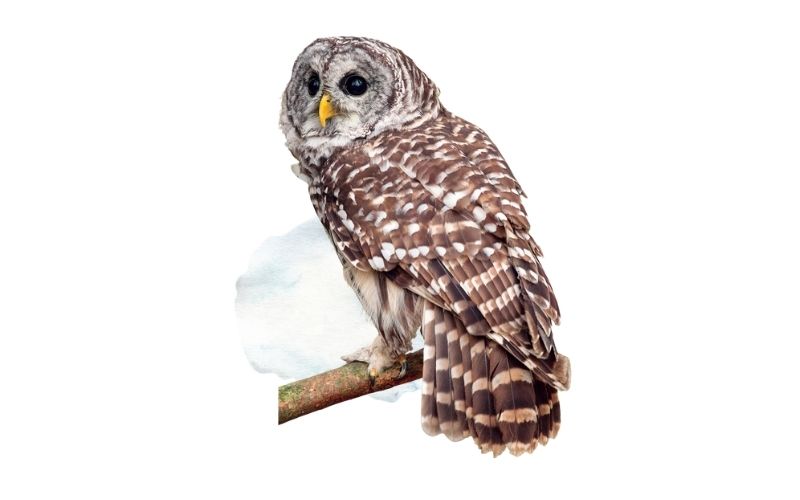
A barred owl watched carefully as the group continued down the boardwalk…..
A guided tour of Florida’s largest state park, the Fakahatchee Strand Preserve State Park, began the quest for native orchids, bromeliads and ferns. With curiosity piqued, the quest expanded to include Florida panthers, Florida black bears and bald eagles. American alligators and gopher tortoises were abundant on the Everglades Trail where site plans include panther crossings.
Blue flag irises were in full bloom under the cypress at the National Audubon Society’s Corkscrew Swamp Sanctuary. A red-shouldered hawk nested and hunted to the sound of the pileated woodpecker drumming on hollow trees. A barred owl watched carefully as the group continued down the boardwalk, while a raccoon observed from behind a cypress knee. The great crested flycatcher, eastern phoebe and Carolina wren were identified by sight and sound.
Before leaving the sanctuary, the group had an opportunity to visit and learn about the Living Machine, a water treatment system that restores wastewater to near-drinkable quality using sunlight, bacteria, nutrient-absorbing wetland plants and animals.
“The Garden Club of Virginia exists to celebrate the beauty of the land, to conserve the gifts of nature and to challenge future generations to build on this heritage.”
These worthy goals have guided the Garden Club of Virginia since 1920.
> Learn More
© 2008-2026 The Garden Club of Virginia. All Rights Reserved