

Restoration and Research Fellowships
February 15, 2022
Chairman Lucy Ellett, Mill Mountain Garden Club
2000 summer and fall committee visits included the Adam Thoroughgood House, Boykin’s Tavern, Bacon’s Castle, Smith’s Fort, Smithfield, Fincastle Presbyterian Church, Lee House and Lee Chapel. Lucy reported on a special tour of three Bremo estates in Fluvanna County built by General John Hartwell Cocke in the 19th-century: Bremo Recess (documented by 1999 Favretti Fellow Chris Stevens), Bremo (documented by 2000 Favretti Fellow Brooke Whiting) and Lower Bremo. Owners of the three properties graciously allowed committee members and their husbands to tour the grounds and two of the houses.
The committee authorized work at Bacon’s Castle, Belle Grove, Belmont, Kent-Valentine House, Stratford, Ker Place, Mary Washington House and Smith’s Fort.
Lucy reported Dogwood Lane at Blandy was progressing nicely with a master craftsman stonemason at work; Lee Hall was waiting on insurance endorsements; and, unfortunately, the Moses Myers House continued to have bureaucratic problems. She also reported that the Garden Club of Virginia was recognized at a reception at Woodrow Wilson Birthplace, where a GCV project to restore the pavilions and the well house were complete.
The committee learned that several large trees had been cut down on the UVA campus over the 2000 Christmas vacation, “ostensibly for safety reasons.” One of the trees was located in Pavilion III, another in Pavilion IV. The committee agreed to send a letter to the Chief Facilities Officer of the University of Virginia, expressing concern and reminding him of the 1993 legally binding agreement between UVA and GCV.
2001 winter and spring committee visits included Scotchtown, the Kent-Valentine House, Wilton, Maymont, Woodlawn, Montpelier and UVA Pavilion Gardens. The UVA visit confirmed the need for major Pavilion renovations. Trees had matured, some removed, some needing removal; plant material had died out; and current plants bore little resemblance to the original Alden Hopkins plan. Mary Hughes, Landscape Architect at UVA, offered funds to begin the restoration at Pavilion III under the direction of Will Rieley
The committee authorized maintenance and updates at the Kent-Valentine House, Mary Washington House, Ker Place and the Mary Washington Monument; as well as assistance with landscape planning at the Sutherlin Mansion in Danville, Boykin’s Tavern in Isle of Wight County and Bruton Parish Church in Williamsburg.
A restoration maintenance workshop was held at Lewis Ginter on March 7, 2001, chaired by Mary Lou Seilheimer and Katty Mears. Attendees included executive directors, gardeners and horticulturists from GCV restoration properties.
The Gillette garden restoration at the Executive Mansion in Richmond was presented on April 16, 2001. The project’s success was credited to cooperation between the State of Virginia, the Garden Club of Virginia, William D. Rieley, the Waynesboro Nursery and the labor force at the Executive Mansion. First Lady of Virginia Roxanne Gilmore presented the Garden Club of Virginia with a framed picture of Charles Gillette’s original garden in appreciation. Following the presentation, attendees were invited to a reception and were offered tours of the mansion.

2001 summer and fall committee visits included Rosewell, The Mews, St. John’s Church, Centre Hill, Belle Grove, Blandy Experimental Farm, Burwell-Morgan Mill, Dodona Manor and Oatlands.
The committee authorized work at Kenmore, Portsmouth Courthouse, Smithfield, Smith’s Fort, Wilton, Bruton Parish and Lee Chapel. Committee members Margaret Bemiss and Nancy Talley were investigating a reprint of Dottie Williams’s 1975 publication Historic Virginia Gardens.
The committee agreed to accept UVA’s recent offer to restore the Pavilion III garden under the supervision of Will Rieley.
The Capitol Square Preservation Council, chaired by former GCV President Betty Schutte, had called for public proposals for a landscape architect to develop a master landscape plan, estimated at $100,000. As a standing member of the Capitol Square Preservation Council, the committee approved a future donation of $25,000 to be applied toward the plan.
The presentation of the Bowling Green at Mount Vernon was held on October 21, 2001. It was unfortunate that Rudy Favretti was unable to attend, as this was his final project for the Garden Club of Virginia. Will Rieley read notes on Rudy’s behalf. The Bowling Green was originally planned and planted by George Washington, and the 1999 restoration included many of the plants used during Washington’s era. The presentation began at 5:45 p.m. and was followed by a reception on the piazza of Mount Vernon, hosted by the Mount Vernon Ladies Association.
2002 winter and spring committee visits included Point of Honor, Moses Myers House, Portsmouth Courthouse and Lee Hall.
The committee authorized work at Fincastle Presbyterian Church, Lee Chapel, Mount Vernon, Scotchtown, Smith’s Fort, Lee Hall, UVA, Kent-Valentine House, Wilton, Moses Myers House and Portsmouth Courthouse. The committee continued to investigate reprinting Historic Virginia Gardens.
The Moses Myers House project required last minute repairs when electrical work in the garden caused a great deal of damage to brick that had been laid and to the sundial which had been given by the Garden Club of Norfolk. Lucy acknowledged the Garden Club of Norfolk, Harborfront Garden Club and the Virginia Beach Junior Garden Club for their substantial contributions to cover the cost of lighting in the garden.
The second announcement was a proposal for final landscape plans, construction documents and subsequent implementation of the plans at Dodona Manor, former home of General George C. Marshall in Leesburg. In 1998, the Restoration Committee had directed Will Rieley to prepare a conceptual plan for four acres covered by a TEA-21 grant. Will presented slides of Dodona Manor, showing the property with conceptual plans, and described plans for the restoration. The project was enthusiastically endorsed by attendees.
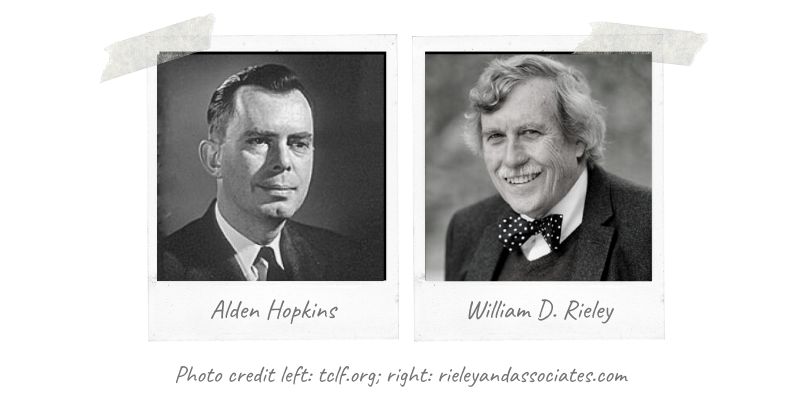
Lucy was pleased to report on recognition recently received by two GCV landscape architects. In celebrating the birthday of Thomas Jefferson, the University of Virginia held a luncheon, awarded medals in the fields of law and architecture and planted a tree in memory of Alden Hopkins, Landscape Architect of the Garden Club of Virginia, who was responsible for the design of the West Lawn Pavilion gardens in 1947-1953. He was also partially responsible for the design of the East Lawn Pavilion gardens but died before the project was complete.
The Virginia Society of the American Institute of Architects awarded “Society Honors” to Garden Club of Virginia Landscape Architect Will Rieley as one whose efforts have positively influenced the built environment. Specifically mentioned was his work in sustaining the high quality of Virginia’s historic landscapes. She then introduced Will Rieley who presented slides of work in progress at the Moses Myers House and Lee Hall and described plans for the 2002 Favretti Fellowship site, Old Mansion.
Research Fellowships
View Fellowship Research Archives
Adriane Fowler of the UVA landscape architecture program was named 2001 Favretti Fellow; she was selected to make measured drawings at Bremo in Fluvanna County. The drawings will complete the 2000 research at the same property by Favretti Fellow Brooke Whiting.
2001 Favretti Fellow Jocelyn Chorney, University of Manitoba in Winnipeg. was selected to document Lower Bremo, the smallest of General John Hartwell Cocke’s three Bremo plantations.
Sarah Trautvetter, graduate student in the MLA program at the University of Virginia, was selected as the 2002 Favretti Fellow, to document Old Mansion, an early 18th-century house in Bowling Green, described as a “blue chip” architectural specimen of the Colonial Chesapeake Bay area style and as a threatened landscape. The property included large groupings of dwarf boxwood in front of the house, geometric plantings of boxwood to the east of the house, and an allee of American hollies of considerable stature. Sarah provided an informative report on her work at the spring 2003 Annual Meeting in Fairfax.

“The Garden Club of Virginia exists to celebrate the beauty of the land, to conserve the gifts of nature and to challenge future generations to build on this heritage.”
These worthy goals have guided the Garden Club of Virginia since 1920.
> Learn More
© 2008-2026 The Garden Club of Virginia. All Rights Reserved