

Restoration and Research Fellowships
February 2, 2022
Chairman Nancy Talley, Winchester-Clarke Garden Club
The Restoration Committee agreed in 1998 to fund two studies at Gunston Hall (geophysical survey and topographical survey) as part of that property’s landmark investigation of the historic grounds. And Chairman Nancy Talley reported that Mr. Favretti’s plans for the Mount Vernon project “appeared to include every shrub known in Washington’s day.” It was noted that Mr. Favretti will complete his work at St. John’s Church and will see Mount Vernon to completion, ending 20 years with the GCV. In Mr. Favretti’s honor, the GCV Fellowship was renamed the Rudy J. Favretti Fellowship.
The committee was invited for a fall lunch at Glen Burnie, a newly opened house museum in Winchester with notable and beautifully maintained gardens. The fall business meeting was held at Dodona Manor in Leesburg, an 18th-century farmhouse home to General George Marshall. The property received a grant from the Virginia Department of Historic Resources to restore the home and a grant from the Transportation Equity Act for the 21st century (TEA-21) to restore the landscape. The Marshall Center requested GCV assistance in implementing the TEA-21 grant, and the Restoration Committee voted to direct Mr. Rieley to provide plans, “not to be construed as a promise to return to restore the grounds to the Marshall period.”
Mr. Rieley’s first major assignment was for the Moses Myers House landscape restoration in Norfolk where documentation suggested a more elaborate plan than the Favretti plan approved at the 1998 Annual Meeting.
A 1999 GCV Maintenance Workshop was held at Montpelier on February 25 for restoration property gardeners. Diane Wilson Director of Grounds at Montpelier; David Berreth, Director of Belmont; Nancy Caruthers, chairman of the Belmont garden committee; and Peter Hatch, Director of Gardens and Grounds at Monticello each addressed problems in maintaining historic gardens.
Restoration Committee members attended a rededication at St. John’s Church in Richmond on April 18, 1999. GCV had provided a master plan in 1983, and Mr. Favretti had provided more detailed directions for renovation in 1997. Following Mr. Favretti’s plan, GCV funded removal of trees and stumps and the planting of new trees.
Spring and summer activity included a decision to fund two, limited, graduate student research projects under the direction of Mr. Rieley, for the purpose of locating existing garden documentation at Centre Hill in Petersburg and Lee Hall in Newport News. Other committee actions included authorization to prune the “goodly row of cedars” at Christ Church, Lancaster; approval of Mr. Rieley’s plans for the TEA-21 grant at Dodona Manor; approval of his conceptual plan at Lee Hall; and the adoption of a lighting policy to discourage dramatic lighting in historic properties.
Following the damage caused by Hurricane Floyd in 1999, the committee voted to make a $1,000 donation to the Franklin Garden Club following extensive flood damage to the club’s civic planting project at Barrett’s Landing Park. The funding would be used to replant trees lost during the storm.
First Lady Roxanne Gilmore approached the Garden Club of Virginia in late 1999, requesting a restoration of the formal garden on the south side of the Executive Mansion. Charles Gillette designed and installed the original garden in the mid-50s, and it had suffered during renovations to the mansion. The garden, a highly visible outdoor room for entertaining, needed to be ready for Historic Garden Week 2000.
The committee engaged retired GCV Landscape Architect Rudy Favretti to produce a Maintenance Manual to be used at all properties, estimated to be a three-year project.
Nancy Talley reported at the spring 2000 Annual Meeting that the Preservation Alliance of Virginia, at its annual meeting on April 15, awarded its highest honor, the Katherine Glaize Rockwood Award, to the GCV Restoration Committee. She also reported that in spite of immense bureaucratic problems, the Gillette garden restoration at the Executive Mansion was completed on April 14, 2000; the Maymont garden was flourishing, as was the bowling green at Mount Vernon; and the Moses Myers House landscaping restoration project was held up while the City of Norfolk removed rubble from adjacent construction of MacArthur Center.
She moved to approve two properties for restoration. The first, at Blandy Experimental Farm (State Arboretum of Virginia) in Boyce, to restore a significant stone wall believed to have been built in the 1830s. The wall was planted with dogwoods in the 1930s, and the old road, which led from the Tuleyries to the main Millwood road is now called Dogwood Lane. The property is owned and administered by UVA. The second restoration at Lee Hall, the 1859 farm and residence of Richard Decatur Lee, near Newport News, was to retore grounds surrounding the house, to include fencing, tree planting, and stabilization of Civil War breastworks. Motions were seconded and passed.
Research Fellowships
View Fellowship Research Archives
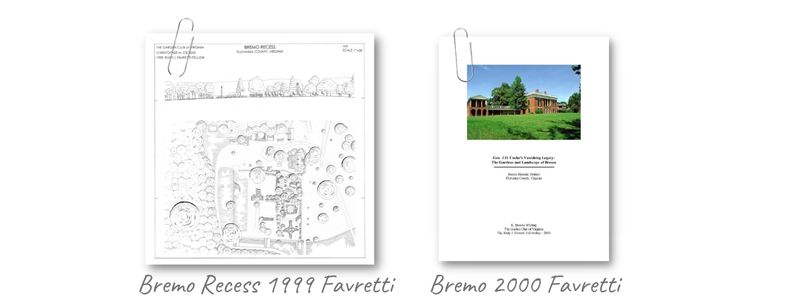
Christopher Stevens, graduate student in landscape architecture at UVA, was selected as the 1999 Rudy J. Favretti Fellow to make measured drawings at Bremo Recess, the first of General John Hartwell Cocke’s three mansions of the Upper James. The house, a fine example of Jacobean architecture, was designed to resemble Bacon’s Castle, the first home of General Cocke, who lived at Bacon’s Castle while building Bremo Recess. Like Bremo and Lower Bremo, Bremo Recess has remained in the Cocke family.
Before undertaking measured drawings, Christopher wrote a paper on General Cocke, who built all three Bremos. He expressed interest in future collaborative work with an archaeologist from SUNY who had finished a three-year project at the Recess over the summer. The three Cocke family houses together comprise a National Historic Landmark on the Upper James River south of Charlottesville.
The 2000 Favretti Fellow K. Brooke Whiting, candidate for MLA at the University of Pennsylvania, was selected to document Bremo, the second of the Bremo complex houses, often called the most perfect Palladian house in Virginia.
“The Garden Club of Virginia exists to celebrate the beauty of the land, to conserve the gifts of nature and to challenge future generations to build on this heritage.”
These worthy goals have guided the Garden Club of Virginia since 1920.
> Learn More
© 2008-2026 The Garden Club of Virginia. All Rights Reserved