

Restoration and Research Fellowships
April 11, 2022
Chairman Bessie Carter, The James River Garden Club
“We wish you could all be with us as we tour, as it makes you so proud of what is in Virginia and what the Garden Club of Virginia has contributed by our restorations, or, more often, our effort to create an appropriate landscape for a historic structure.” Bessie Carter, 2002 Board of Governors
Committee 2002 summer and fall visits included the Adam Thoroughgood House, Portsmouth Courthouse, Ker Place, Smith’s Fort, Bruton Parish, Bacon’s Castle, St. Luke’s Church, Stratford, Belmont, Mary Washington House, Mary Washington Monument and Kenmore.
The committee signed an agreement with Dodona Manor to provide conceptual plans and construction documents for the landscape restoration funded by TEA-21 and overseen by Will Rieley; provided landscape working drawings for Bruton Parish Churchyard; agreed to provide a landscape plan for St. Luke’s Episcopal Church; approved the first Restoration Committee Maintenance Manual prepared by former GCV Landscape Architect Rudy Favretti; and agreed to donate $3,000 to the Cultural Landscape Foundation and Gunston Hall for a symposium at Gunston Hall featuring Charles Birnbaum.
The committee also reviewed requests from Hollins University for assistance with the Beale Memorial Garden and from the Fairfax Park Authority for assistance with Green Spring Gardens.
Because the garden at Woodlawn appeared to be in poor shape, with management claiming a lack of National Trust funding and difficulty in securing experienced gardeners, a simplified plan for the garden was suggested.
A follow-up discussion of assistance with landscaping at the Danville Museum of Fine Arts and History (formerly the Sutherlin Mansion) led to an agreement to restore the historic perimeter fencing.
The committee agreed on a collaboration with Sweet Briar College on the recently approved restoration. GCV agreed to landscape the front quadrant of the garden in front of the President’s House with retaining walls, paths, plantings and pruning. The new front entrance would feature an arrival court with a direct path to the front of the house. The arboretum around the house, begun in the early 1800s, would be enhanced with additional trees such as cryptomeria, Parrot Tree, white oak and golden rain trees. The college agreed to improve the existing roadway.
Margaret Bemiss, liaison to the Executive Mansion Gillette garden, was asked not to visit because the garden was so distressing after the 2002 summer drought. Water restrictions were in place statewide and she was informed the Executive Mansion was no exception — the Governor had forbidden watering in the garden. The committee later agreed to replace the plants that did not survive.
Landscaping brickwork at the Kent-Valentine House was an ongoing source of frustration throughout Bessie’s tenure as Restoration Chairman. A contractor initially installed orange brick edging and, when he was informed the brick did not meet specifications, he walked off the job. Next, a structural engineer was called in to examine the bulging brick wall at the rear of the house, thus beginning a two-year “battle” with the City of Richmond. The Architectural Review office of the city reviewed and approved the plan. The Zoning office denied the building permit because the local ordinance that did not allow walls along the property line to exceed 6-1/2 feet in height. Back to the drawing board. The board of Zoning Appeals was to meet September 3, and the full Restoration Committee threatened to show up in full force which should “terrify the bureaucracy.” (Margaret Bemiss, Helen Pinckney, Annabel Josephs, Will Rieley and Bessie Carter actually did show up). The permit was finally approved on September 10. In the meantime, the price of concrete had doubled. Then, after taking down the wall, it was discovered the design needed to be revised again because excavation would cut through the roots of the hollies. By this time, the contractor was committed elsewhere and a third contractor had to be found. The wall was finally finished on April 16, 2004 — one month before Bessie’s term as Restoration Chairman was to end.
As a note of interest, Bessie announced that Belle Grove would become part of Cedar Creek and Belle Grove National Park, effective December 2002. She also reported that Kenmore, in a measure to protect the roof and old windows, had removed two willow oaks planted by Alden Hopkins in 1959 to frame the house. The committee was disappointed with the decision as experts had deemed the trees safe and healthy.
The Restoration Committee’s Maintenance Workshop, chaired by Helen Murphy and Margaret Bemiss, was held in February 2003 at Lewis Ginter. Mitch Van Yarhres spoke on care of historic trees and Peggy Singlemann of Maymont spoke on shrubs.
2003 winter and spring visits included Smithfield in Blacksburg, Fincastle Presbyterian Church, Lee Chapel, the President’s House at Washington and Lee University, Hollins University and the Woodrow Wilson Birthplace.
Business discussions included the landscape plan at St. Luke’s Church in Smithfield and the threat of adjacent housing plans. The church was built in 1632 and is the oldest Gothic structure in the country, called a “national shrine” by President Eisenhower. Learning that a developer had bought the adjoining golf course and planned to build houses on it, GCV provided a plan to include screening.
The Moses Myers House was presented to the Chrysler Museum on May 4, 2003, after being plagued by numerous bureaucratic problems. The garden was described as “a beautiful green oasis in a downtown city setting.” The Garden Club of Norfolk and Harborfront Garden Club contributed to the lighting, and the Virginia Beach Junior Garden Club gave the granite bed for the fence.
Committee visits continued throughout the summer and fall of 2003 and included Montpelier, Monticello, UVA Pavilion III, Centre Hill, the Executive Mansion, Maymont, the Kent-Valentine House, the Grace Arents Garden at Lewis Ginter, Dodona Manor, Oatlands, Blandy, the Burwell Morgan Mill and Belle Grove.
The committee agreed to restore the Beale Memorial Garden at Hollins University and authorized Will Rieley to update a Favretti plan at Centre Hill. Ongoing maintenance work included tree replacements at Belmont and Bacon’s Castle; evaluating stone and brick work needs at Montpelier; a new arbor at the Mary Washington House, based on the original Gillette design; new garden gates at Woodlawn, based on the original Hopkins design, and plans for a new fence to surround Nelly’s garden; and a search for ways to make a meaningful contribution to the upcoming Jamestown quadricentennial celebration. A plan for the Adam Thoroughgood House to improve walkways was on hold as contract negotiation continued following the transfer of property ownership from the City of Norfolk to the City of Virginia Beach.
Lee Hall was presented to the City of Newport News on September 28, 2003. The 19th-century landscape plan was installed with different fencing throughout to reveal the varied styles used, depending on their proximity to the house.
The stone walls a Blandy Experimental Farm were presented on May 2, 2004. Winchester-Clarke Garden Club planted the dogwoods.
Research Fellowships
View Fellowship Research Archives
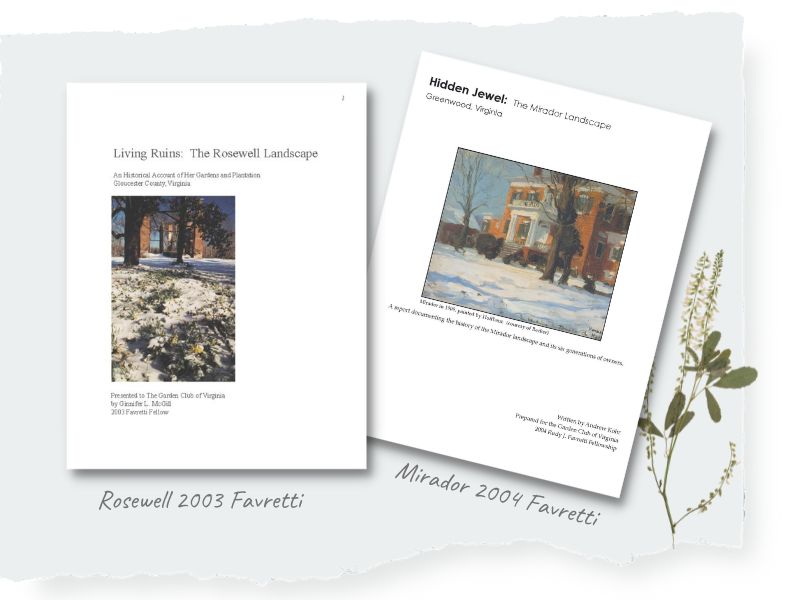
Gennifer McGill, UVA School of Landscape Architecture 2003, was selected to document Rosewell in Gloucester County. The original structure, built in 1730 by Mann Page, burned in 1916, leaving a magnificent brick ruin. The Rosewell Foundation only owns a few acres and the adjacent property between the house and river is vulnerable to development. Gennifer’s report was so successful that Rosewell has asked if they could get it printed to sell in their gift shop.
2004 Favretti Fellow Andrew Kohr from Ball State University researched the gardens at Mirador in Charlottesville, home of the Langhornes.
The Board of Directors voted in winter 2004 to create a new Garden Club of Virginia fellowship to document historic gardens and landscapes in Virginia NOT held in private ownership – churches, foundations and public entities.
“The Garden Club of Virginia exists to celebrate the beauty of the land, to conserve the gifts of nature and to challenge future generations to build on this heritage.”
These worthy goals have guided the Garden Club of Virginia since 1920.
> Learn More
© 2008-2026 The Garden Club of Virginia. All Rights Reserved