

Restoration and Research Fellowships
October 26, 2022
Chairman Deedy Bumgardner, The Augusta Garden Club
The Restoration Committee met June 7-8, 2010, and visited Lee Hall in Newport News, Historic St. Luke’s Church in Isle of Wight County, Bacon’s Castle and Smith’s Fort in Surry County and Bruton Parish churchyard in Williamsburg. Elizabeth Kostelny and Louis Malon from Preservation Virginia joined the committee for tours of Bacon’s Castle and Smith’s Fort. The committee reviewed the following requests:
- landscape design for columbarium at Fincastle Presbyterian
- landscape design for UVA Pavilion VI garden to add protection for the Merton Spire
- repair crumbling wall at Montpelier
- remove dead trees at Belle Grove, Kenmore and St. Luke’s
- replace fence and trellis at Mary Washington
Upon removal of a dead walnut tree and dying boxwood at Smith’s Fort, a palisade trench and probably a grave were uncovered. Preservation Virginia conducted minimal archaeological work and the findings were considered significant. Due to lack of funds and time, the recommended course of action was to conduct no further digging, cover the area with a protective piece of filter fabric, put top soil and ground cover over the covering, and to not replace any other planting.
The committee met September 14-15, 2010 and visited the Danville Museum of Fine Arts and History, Sweet Briar College in Amherst, Point of Honor in Lynchburg, Poplar Forest near Lynchburg, Hollins University’s Beale Garden, and Fincastle Presbyterian Church.
The committee reviewed the following requests:
- design tree screening to mitigate the view of the nearby large quarry, to restore a lilac hedge, and to replant several trees at Belle Grove
- replace dying Liberty Elm trees planted 15 years ago at Maymont with Princeton Elms
- plant a serviceberry tree, add more plum yews, and replace one of the pencil boxwoods at the Kent-Valentine House
- replace a tree and some boxwood at Belmont
- continue repairing and replacing the garden steps at Stratford Hall
- work with Laurie Ossman, Director at Woodlawn, to implement the idea of growing organic vegetables and fruits in the Hopkins design
- replace dying boxwood with a more sun-tolerant Justin Brouwers at Wilton
Chairman Deedy Bumgardner reported at the 2010 fall Board of Governors that revisions to the Maintenance Manual were in progress, that the digitization project being done by the Virginia Historical Society was proceeding slowly and then reminded attendees that the Restoration Committee has a PowerPoint program about GCV restorations and would love to give it. Landscape architect Will Rieley shared an informative history of Poplar Forest and the project for landscape restoration. Attendees voiced overwhelming support for the project.
Poplar Forest, Thomas Jefferson’s personal retreat near Lynchburg, has been described as part architectural masterpiece, part engineering marvel and part work of art. It is the living embodiment of Jefferson’s genius, blending landscape and architecture. After years of restoring the house, Poplar Forest is ready to start the first phase of landscape restoration that begins with restoring the west allee of paper mulberry trees — linking the octagonal house to the earthen mound — illuminating Jefferson’s blending of architecture and plantings to interpret Palladian architecture. This allee balances the wing of offices on the east side of the house. His records showed that trees were planted in November 1812, but the details were lacking.
A grant from the Institute of Museum and Library Services facilitated archeological work that revealed details about four tree “clumps” that Jefferson planted around the house, placing two such groupings of trees at the front of the house and two at the back. The research also revealed that he planted three oval planting beds in the front of the house. The tree clumps contained Athenian and balsam poplars, intermixed with black locust, Kentucky coffee trees, redbuds, dogwoods, calycanthus and Liriodendron. The oval beds were planted with different kinds of roses and shrubs.
Poplar Forest first approached the GCV Restoration Committee and proposed a three-phase restoration – Phase I to restore the west allee of paper mulberries; Phase II to restore two tree clumps and two of the three oval beds; and Phase III to restore the carriage turnaround and to restore the third and final oval bed. Phases I and II were endorsed by membership at the 2010 fall Board of Governors and Phase III at the 2012 spring Annual Meeting.
Phase I was completed in December 2011 as work on Phases II and III continued. Photos
The Restoration Committee met at the office of Rieley & Associates in Charlottesville on January 18-19, 2011, for a comprehensive review and update of its policies and procedures that included general policies, lighting archeology, maintenance, project costs, design ownership, signs, plaques, labels and graphic material and watering.
The committee’s Maintenance Workshop was held February 15, 2011, at Belmont, chaired by Charlotte Benjamin and Kay Van Allen. The workshop was attended by an unusually large number of representatives from numerous properties. The revised Maintenance Manual was distributed and attendees expressed appreciation that the informative talks covered topics of interest and they benefitted from the networking. The workshop is free and held every two years by the Restoration Committee for the benefit of the gardeners and workers at the restoration properties.
The landscape restoration at John Handley High School was presented by the Garden Club of Virginia on March 23, 2011. Photos
Deedy reported at the 2011 spring Annual Meeting on progress of Phase II restorations at the Moses Myers House in Norfolk to complete the restoration originally planned but never fully implemented. Will Rieley and liaison Judy Perry met with the retiring Deputy Director of the Chrysler Museum and the person who will be taking responsibility for the Moses Myers House to review the proposed plan. They are currently reviewing it and, when officially approved, we will begin work on construction documents.
GCV Landscape Architect William D. Rieley, gave an informative slide presentation about recent restoration work and highlighted the Historic Henry County Courthouse in Martinsville. Attendees endorsed the project unanimously.
History Henry County Courthouse, first constructed in 1793, is an historic landmark in Martinsville. The Restoration Committee received an application for landscape restoration in August 2010. At its September meeting the committee considered the request and a fact-finding delegation visited the site early in November. After that initial visit, Will Rieley began working with the representatives and developed a design that was approved by both sides. At the March 2011 meeting the committee endorsed the project — to develop the grounds as a green space in front of the Historic Henry County Courthouse, which is owned by the Martinsville-Henry County Historical Society. The Historical Society has completed work restoring the building, and the City of Martinsville has been most cooperative and is working closely with GCV, since a portion of the land that is being included in the renovation belongs to the city. The representatives from the Historical Society have also asked the Harvest Foundation to join in paying for certain parts of the new landscaping, which they have agreed to do.
The Restoration Committee met June 7-8, 2011, and toured the Woodrow Wilson Presidential Library in Staunton, Monticello and the ten Pavilion gardens at UVA in Charlottesville, and Montpelier in Orange.
The committee met in September 2011 and toured the Grace Arents Garden at Lewis Ginter Botanical Garden in Richmond and Centre Hill Mansion in Petersburg, where an extensive drainage system was being installed.
Deedy announced at the 2011 Board of Governors that the committee and the Board of Directors have accepted the withdrawal of the Lee House Garden at Washington and Lee University as a Garden Club of Virginia restoration after two years of discussion. The 1992 GCV garden will serve as backbone for the significant renovations that are planned to accommodate changes in the use of the area. Deedy emphasized that neither party has plans to suggest changes to the existing relationship concerning Lee Chapel.
She further reported that Phase I of a digitization project in partnership with the Virginia Historical Society has been completed, detailing the work of twenty GCV restoration projects.
She outlined some of the major requests that had recently been approved for existing properties, adding that her committee anticipated additional requests after the damage from Hurrican Irene was assessed:
- replace rotting trellises at Belmont
- grade landscaping at new entrance gate at Ker Place, replace gravel walkways, and repair disabled-access walkway
- continue replacing/repairing of the sets of steps until all are repaired at Stratford Hall
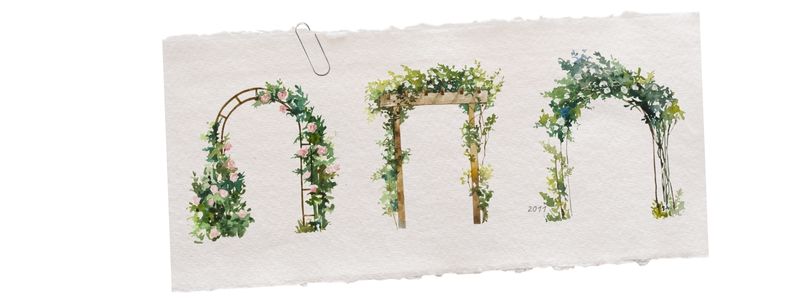
- replace two rose arbors and gazebo at the Grace Arents Garden at Lewis Ginter Botanical Garden
- continue to work with John Handley High School, the Handley Trust and the Winchester School Board in developing the master plan for the park and area surrounding the school
- repair to exterior walls, chimneys, garden wall, and columns at the Kent-Valentine House.
Will Rieley then shared updates on current work at the Historic Henry County Courthouse, Poplar Forest, Hampden-Sydney College and the Green Spring Gardens. The Green Spring project and the gift to Hampden-Sydney College were endorsed by membership.
Green Spring Gardens is a public garden and historic site operated by the Fairfax County Park Authority. The site is listed on the National Register for Historic Places, the Virginia Historic Landmarks Register and accredited by the Association of American Museums. The mission is to preserve, protect, maintain and interpret the horticultural, historic and natural resources of the site and to provide for the educational and inspirational use of the resources by citizens of and visitors to Fairfax County, Virginia. It is a 31-acre site open to the public seven days a week that has demonstration gardens of many types, natural and planted areas, two historical farm ponds, and conducts horticultural education programs to all ages. There is a historic house (circa 1784) on part of the site. The final owners of the home commissioned Beatrix Farrand to landscape the grounds behind the house. Ms. Farrand is recognized as a pioneer of American landscape design and was the only female among the founders of the American Society of Landscape Architects. In 1942, she visited Green Spring and drew up a preliminary garden design. Green Spring was Farrand’s only documented garden in Virginia, and it was also one of the last commissions of her career. The key elements of her landscape design behind the house remain but there is a need for repair and restoration. The garden has a distinctive curved stone wall with boxwood and a flower bed above and in front of the wall.
Hampden-Sydney College is a distinguished, liberal arts, all-male college near Farmville. The plantation office at Slate Hill, built in the 1870s, was the site where plans were finalized to open the college. In the 1940s, the owners of Slate Hill donated the little building to the college. Known as “The Birthplace,” it is located behind Atkinson Hall which houses the offices of the President, Provost and Dean of Faculty. The college renovated ‘The Birthplace” in 2000, and it is now furnished and used for conferences. Because its backdrop is a parking area, utility building and power lines, the college approached the Garden Club of Virginia about undertaking this area as a project. Will Rieley designed a simple functional design with paths to be straightened, a walkway added to connect a parking area to the terrace at the end of Atkinson Hall, plantings to screen large overhead lines and a few other trees and shrubs to make the area more attractive. Membership approved a motion at the 2011 spring Annual Meeting to give as a special gift to Hampden-Sydney College, the design and its implementation for the area around Atkinson Hall and “The Birthplace.”
The Restoration Committee met in January in Charlottesville at the offices of Rieley & Associates. In March 2012, the committee met and toured Ker Place on the Eastern Shore, Christ Church in Lancaster and Stratford Hall on the Northern Neck. Deedy reported at the 2012 spring Annual Meeting that the committee continued to discuss the ten pavilion gardens at UVA with current focus on the long-range plans for Pavilion X, and consideration of Pavilion I which has issues with disabled access. She reported that Roger Foley had been hired to photograph several restoration sites, and announced that the Maintenance Manual had been reformatted for professional printing and would be offered in CD-format as well.
Will Rieley shared a PowerPoint presentation that included updates on restoration projects that are currently being undertaken: Green Spring, Handley High School, Henry County Courthouse and Poplar Forest.
Research Fellowships
View Fellowship Research Archives
The GCV Fellowships Program, the brainchild of Former GCV President Helen Murphy, was first implemented in 1996. It was begun in a continuing effort to build a comprehensive record of historic gardens in the Commonwealth of Virginia. The William D. Rieley Fellow documents and researches historic landscapes that are not privately held Rudy J. Favretti Fellow documents historic landscapes that are privately owned.
GCV Landscape Architect William D. Rieley, oversees this program and guides the students throughout the summer. The Garden Club of Virginia provides housing and mileage for these young scholars over the summer and, when they complete their work and submit final reports, they are given a stipend. Funding comes from the profits from Historic Garden Week.
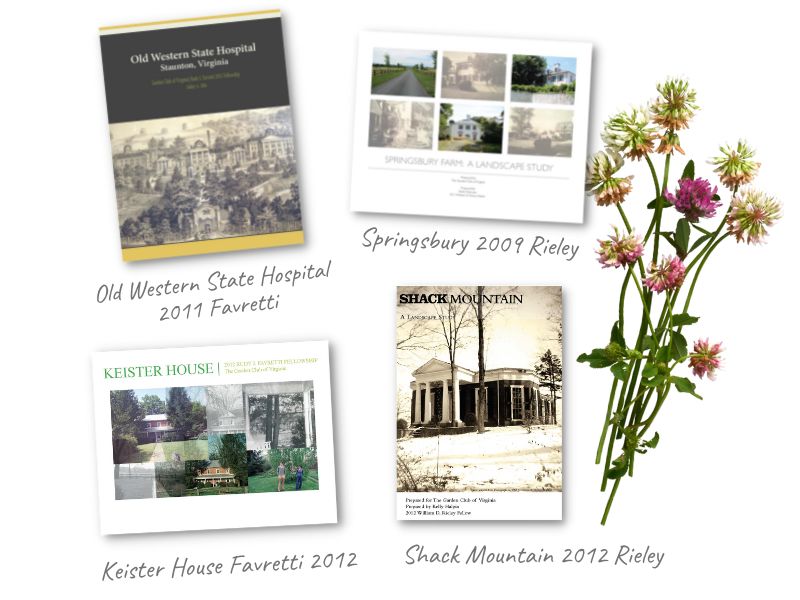
Ashley Allis was selected for the 2011 Rudy J. Favretti Fellowship. She has a bachelor’s degree in landscape architecture and is currently studying for her Masters in Urban and Environmental Planning at the University of Virginia. Ashley documented the landscape at the Old Western State Hospital in Staunton, now owned by a private foundation which is turning the old buildings into condos and eventually a luxury hotel. She uncovered historical documents and descriptions of the hospital which will be invaluable to the new owners as they plan their new site. This was where the first “healing garden” was considered therapy for the inmates. However, Ashley informed us that only the men were allowed to be engaged in this therapeutic gardening activity. The ladies were given sewing and ironing as their therapy.
Emily Peterson was selected for the 2011 William D. Rieley Fellowship. She has a BA in English and Studio Art and is a candidate for a Masters in Landscape Architecture at the University of Virginia. She documented the Ellen Biddle Shipman Garden at Springsbury in Millwood. This property is now owned by the Casey Tree Foundation and is used as their tree farm. Emily was able to visit Cornell University, which is the repository for Shipman’s original plans and drawings. She uncovered many heretofore unknown documents and photographs which are invaluable to the present plans. She presented members of the Restoration Committee, the Fellowship Committee, and the GCV board with a PowerPoint showing her documentary of the landscape and her findings.
Gardner Burg was selected for the 2012 Favretti Fellowship and will document historic Keister House in Blacksburg. He has an undergraduate degree from Ball State University in Landscape Architecture and is now in an Advanced Master of Landscape Architecture at Virginia Tech. While the house is historic, this natural landscape is the creation of David and Lindsay West. Gardner is documenting the plantings as they relate to the natural systems of the site, as well as the native reintroductions and management by the Wests over time.
Kelly Halpin was selected for the 2012 William D. Rieley Fellowship and will document Shack Mountain in Charlottesville. She has an undergraduate degree in history from Temple University and is working on a graduate degree in Landscape Architecture from the University of Colorado at Denver.This delightful house and garden were designed by Sydney Fiske Kimball, Director of the Philadelphia Museum and preeminent architectural historian. It was Kimball who established Jefferson’s reputation as an architect and Shack Mountain is tangible representation of Kimball’s regard for Jeffersonian design. Fellow Kelly Halpin has broken new ground in her research of Fiske and Marie Kimball and the design of both the house and the landscape, as well as the additions and stewardship of subsequent owners, Jane and Bedford Moore.
“The Garden Club of Virginia exists to celebrate the beauty of the land, to conserve the gifts of nature and to challenge future generations to build on this heritage.”
These worthy goals have guided the Garden Club of Virginia since 1920.
> Learn More
© 2008-2026 The Garden Club of Virginia. All Rights Reserved